Tripartite agreement for energy storage to accelerate Europe’s clean energy transition
The European Union estimates that at least 200 GW of energy storage capacity will be needed by 2030 to support the clean energy transition and ensure a reliable electricity system. To help close this gap, the European Commission has launched the first tripartite agreement for energy storage, a collaborative framework bringing together public authorities, industry and financial stakeholders to speed up the deployment of storage technologies.
The initiative aims to deliver at least 45 GW of new storage capacity by 2028, and the commitments already submitted by Member States suggest the target is within reach. Twenty-two countries have so far presented national deployment plans representing 30 to 35 GW of new capacity. These commitments extend beyond battery energy storage systems (BESS) to include hybrid projects, thermal energy storage installations and battery gigafactories.
“Energy storage is the missing link in the clean energy transition,” said Dan Jørgensen, European Commissioner for Energy and Housing. “Through tripartite agreements, we are introducing an innovative model that brings together industry and the public sector. As Europeans, we believe that cooperation in strategic sectors is essential to make energy cleaner, more affordable, while strengthening our competitiveness and economic resilience.”
How the Tripartite Agreement for Energy Storage will work
The success of the initiative will depend on coordinating a broad range of stakeholders around a shared objective. Project developers, energy-intensive industries, financial institutions, Member States and the European Commission will all contribute to expanding Europe’s storage capacity during the 2026-2028 period.
The agreement sets a deployment target equivalent to a 20% increase compared with the approximately 12 GW of storage capacity expected to be installed in 2025. Achieving this growth would bring total new deployment to around 45 GW by the end of 2028.
Doubling storage contribution during peak electricity demand
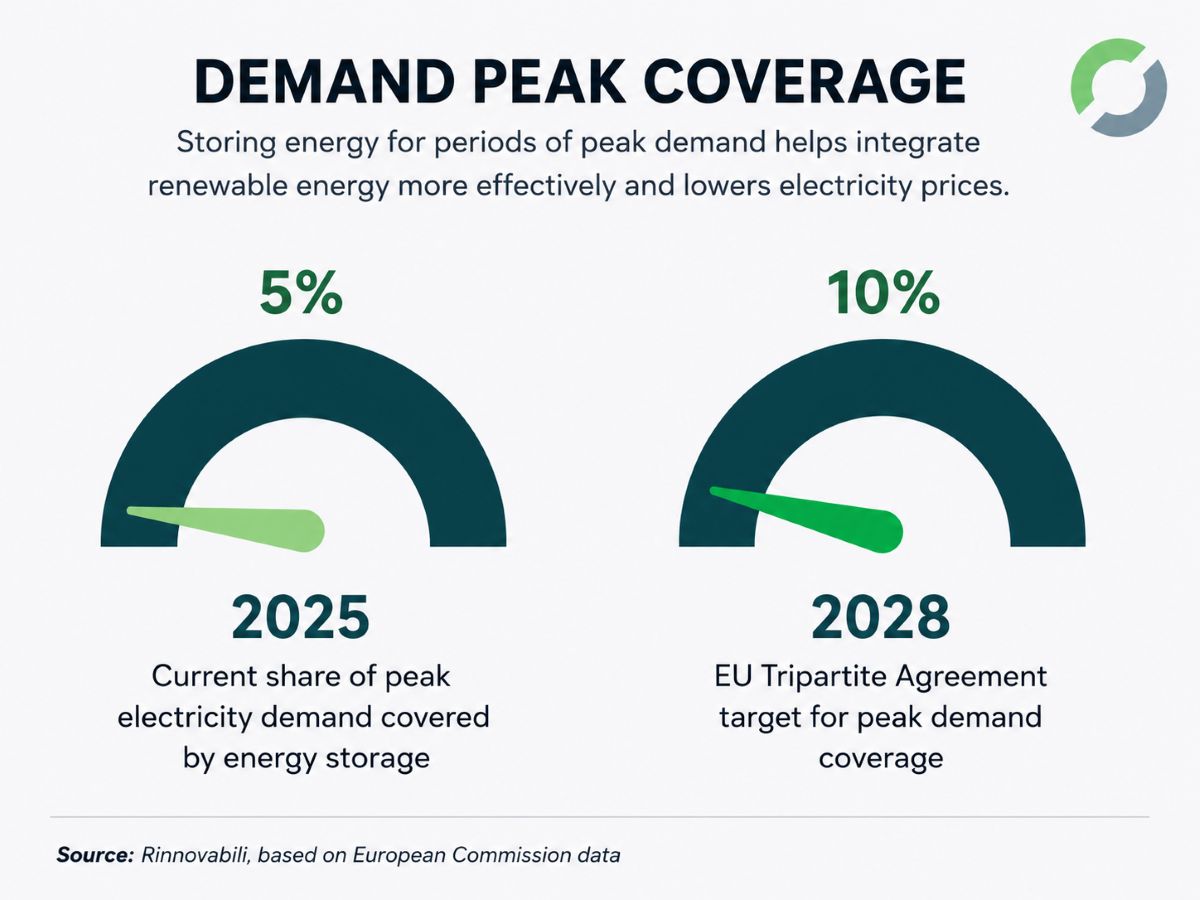
The additional storage capacity is also expected to achieve a second strategic objective: increasing storage’s contribution to peak electricity demand from roughly 5% in 2025 to 10%, improving the integration and use of renewable electricity across the European grid.
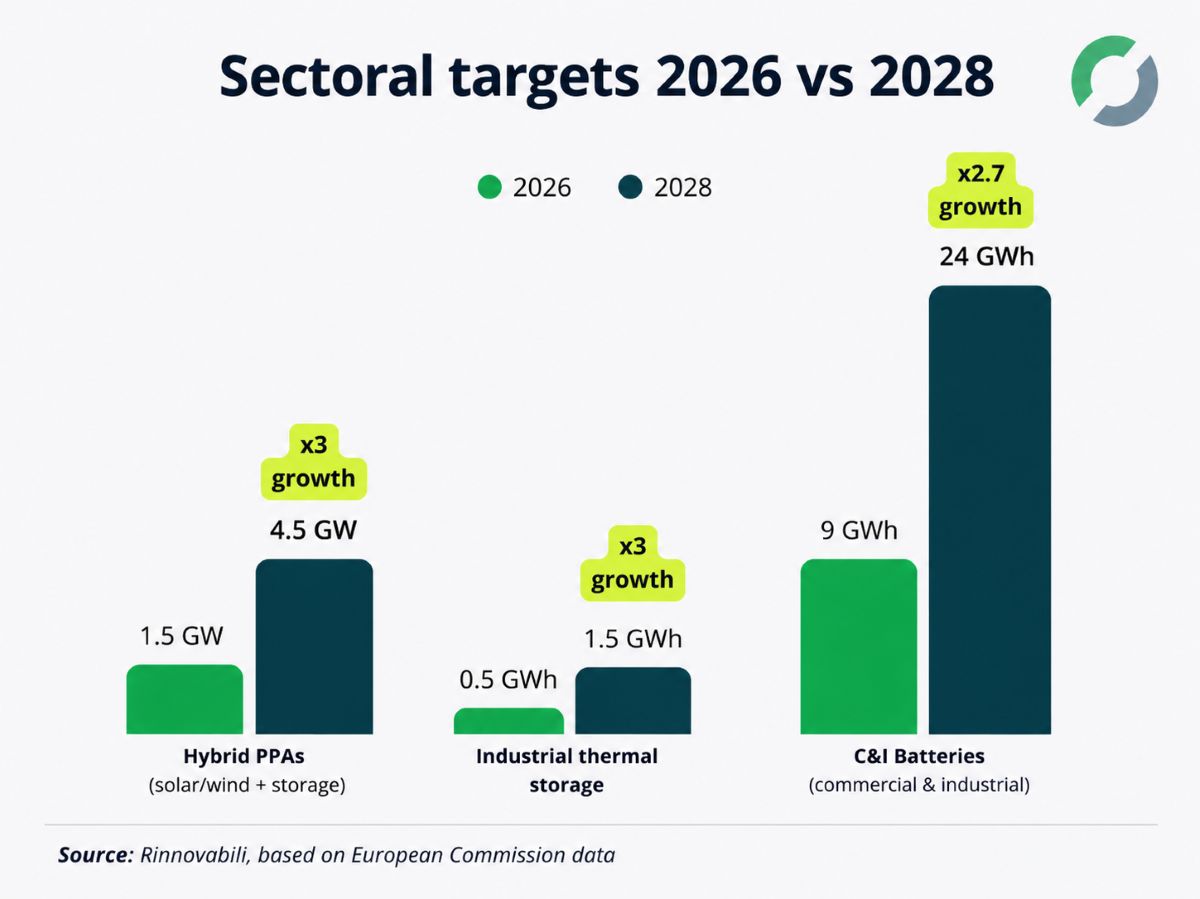
The plan also foresees a significant expansion of flexible and hybrid Power Purchase Agreements (PPAs) that combine solar or wind generation with battery storage. Their cumulative capacity is expected to grow from 1.5 GW in 2026 to 4.5 GW by 2028.
At the same time, electrochemical storage in the commercial and industrial (C&I) sector is projected to increase from 9 GWh in 2026 to 24 GWh in 2028, while industrial thermal energy storage is expected to rise from 0.5 GWh to 1.5 GWh over the same period.
Who will deliver the commitments under the Tripartite Agreement for Energy Storage?
Under the Tripartite Agreement for Energy Storage, project developers will provide annual forecasts of new installations, while energy-intensive industries will deploy storage systems at their own facilities and improve transparency by sharing clearer information on when and how much electricity they consume.
“Project certainty and visibility are essential for investors, and this is exactly what our first tripartite agreement delivers,” Commissioner Jørgensen added.
The European Commission also announced complementary financial support through the European Investment Bank (EIB) Group. This includes opening its €500 million pilot programme for Power Purchase Agreements to energy storage projects, alongside extending the €1.5 billion Grids Manufacturing Package to strengthen Europe’s electricity grid supply chain.
National authorities participating in the agreement have committed not only to presenting their national deployment plans for 2026-2028, but also to supporting the sector by implementing cost-reflective and non-discriminatory network tariffs, encouraging greater system flexibility and, where appropriate, providing financial support in line with EU State aid rules.
Italian projects among the first flagship initiatives
At the signing ceremony, industry representatives also presented several flagship projects designed to demonstrate how the Tripartite Agreement for Energy Storage can be replicated across Europe.
The FAENIX project is developing an integrated battery manufacturing platform across two Italian production sites with a combined annual manufacturing capacity of 16 GWh. It includes the Teverola gigafactory, currently under construction, together with the industrial hub in Brindisi.
The GESIIS – Fri-El Project, launched this year, aims to decarbonise large hydroponic greenhouse operations by combining closed-loop geothermal technology with seasonal thermal energy storage.