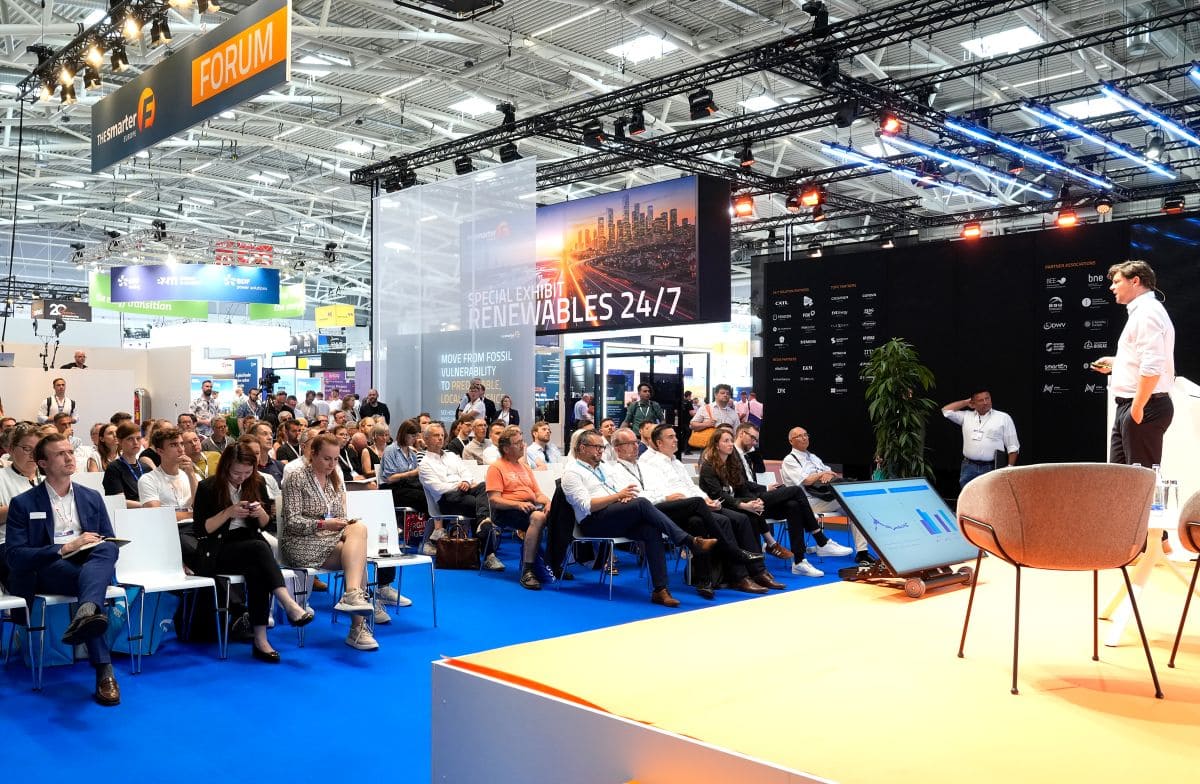
The smarter E Europe highlights the future of 24/7 renewable energy
The 2026 edition closed with record-breaking numbers, bringing together 2,650 exhibitors from 52 countries and 105,000 trade visitors from 163 nations.
The event also delivered a clear message: renewable energy can provide reliable, secure and cost-effective electricity 24 hours a day, seven days a week.
The vision behind The smarter E Europe
We spoke with Horst Dufner, Head of The smarter E Europe, to take stock of the latest developments and understand the driving force behind the event’s long record of success.
Mr. Dufner, since The smarter E Europe was built on the historical foundations established by Intersolar, the energy sector has undergone a profound transformation. The event has consistently anticipated market needs, evolving from a collection of specialized vertical exhibitions into a fully integrated ecosystem. Looking back, what radical changes have had the greatest impact on the development of this event, and what differences between past and current editions stand out most in terms of format and programming?
The turning point for our exhibition alliance was the large-scale adoption and expansion of photovoltaics and battery storage, driven by the sharp decline in the cost of these two technologies over recent years. Both have now become defining energy technologies with dominant market shares.
Last year, 664 gigawatts of new photovoltaic capacity were installed worldwide, enabling the global solar fleet to surpass the three-terawatt (TW) milestone for the first time. In battery storage, Europe added 36 gigawatt-hours (GWh) of capacity in 2025, representing a 48% increase over the previous year and pushing Europe’s total storage capacity beyond 100 GWh for the first time.
PV and battery storage continue to capture an ever-growing share of global energy markets, and this internationalization of the industry has significantly contributed to the success of our event. New business models and technologies are entering the market at a rapid pace, including innovations such as colored solar cells and agrivoltaics. In the storage sector, market growth is being driven entirely by private investment, supported by multiple revenue streams such as energy arbitrage. From a thematic standpoint, our industry is no longer focused solely on generation but increasingly on integrating larger and larger amounts of renewable energy into the grid.
As an event, we have evolved tremendously. We have grown from a solar trade show into a comprehensive energy exhibition offering system-wide solutions across the entire renewable energy value chain. The focus is no longer on individual products but on the efficient interaction of components to achieve a fully integrated renewable energy supply across all sectors. Companies are transforming from manufacturers into solution providers, often offering complete and coordinated portfolios that include inverters, battery storage systems, mounting structures, and energy management solutions. This diversification is accelerating innovation and fostering new business models, something we observed very clearly at this year’s exhibition alliance.
Over the past year, geopolitical tensions and the resulting energy crisis have transformed the green transition from a long-term goal into an urgent matter of national security. How is this strong momentum and sense of urgency reflected in the market? How are the profiles and needs of visitors and exhibitors changing this year?
The urgency is clearly reflected in the tremendous growth of the PV and storage markets. As a result of the current energy supply crisis, many European countries are also seeing equally strong growth in related system solutions and, above all, in electric mobility.
The profiles and needs of visitors and exhibitors are shifting toward a strongly systemic approach to both supply and demand. Photovoltaics, storage systems, and EV charging infrastructure are increasingly being considered together and purchased as integrated solutions. This combination is experiencing a real boom, particularly in the commercial and industrial sectors.
Let’s move to the heart of this year’s event. What were the overarching themes and key focus areas of the 2026 edition, and where did you see the greatest expectations in terms of innovation and business opportunities?
The main theme was clearly around-the-clock renewable energy supply. Discussions focused on its technical feasibility, social benefits, and economic advantages.
This was also the focus of our special exhibit, “Renewables 24/7,” where we used hard data to debunk myths surrounding the variability of renewable generation and periods of low solar and wind output. We did so based on an exclusive study examining a fully renewable energy supply for an industrialized nation such as Germany, where approximately 60% of electricity is already generated from renewable sources. The study was developed in collaboration with the Fraunhofer Institute for Solar Energy Systems (ISE).
This is precisely where we see the greatest potential for innovation and business opportunities. Digitalization and the use of flexibility are creating entirely new solutions that go far beyond simply generating kilowatt-hours. Examples includ intelligent energy management, AI-based forecasting, and grid-supportive control systems.
All forms of energy storage are also attracting significant attention, whether battery storage, green hydrogen production, or the integration of vehicle batteries through bidirectional charging, which is rapidly gaining momentum.
Photovoltaics remains the driving force behind the energy transition. Based on your extensive experience and the technologies showcased this year, which specific innovation trends are currently shaping global competition in the solar market?
First and foremost, a decisive trend is that photovoltaics and battery storage are increasingly being planned and designed together. PV-plus-BESS hybrid plants and the co-location of storage systems behind a single grid connection point are becoming industry standards. While this increases complexity for developers and planners, it also significantly improves the profitability of large-scale solar projects.
In addition, we are seeing growing demand for technologies that enhance grid stability. One key solution is the grid-forming inverter, which provides critical system-support functions and is increasingly being deployed alongside battery storage systems in most major solar markets.
At the cell level, the technological transition is particularly striking. Legacy PERC technology has virtually disappeared, while n-type TOPCon technology has emerged as the clear market leader, accounting for roughly three-quarters of the market.
Heterojunction and back-contact cells occupy the premium segment. The real technological breakthrough, however, is coming from perovskite-silicon tandem technology, which surpasses the efficiency limits of conventional silicon. The first full-size modules have already achieved efficiencies above 32%.
At the same time, competition is shifting from technology to market structure. Manufacturing capacity is now two to three times greater than global demand, and the resulting price war is pushing even market leaders into the red, creating strong pressure for industry consolidation.
The energy storage sector is experiencing a golden age, marked by strong growth in patents, installations, and global investment. Is this exceptionally positive trend directly reflected in product innovation and the number of companies participating in ees Europe?
Absolutely. This year, ees Europe occupied six exhibition halls, while The smarter E Europe hosted a total of 2,650 exhibitors. The trend is also clearly visible in the storage solutions recognized with this year’s The smarter E AWARD. Energy storage systems are evolving from simple energy buffers into active anchors of grid stability.
An increasing number of large-scale storage systems now provide grid-forming functions, black-start capability, and synthetic inertia through their inverters, delivering exactly the system services that were once supplied by conventional power plants.
At the same time, the technology landscape is becoming more diverse. Alongside advances in power electronics and safety, alternative battery chemistries such as sodium-ion technology are maturing rapidly. These technologies eliminate the need for lithium and are already proving themselves in utility-scale projects. In other words, the boom is not merely producing more of the same products; it is delivering fundamentally new and more advanced solutions.
Recently, the clean-tech value chain has become a focal point of intense global tensions and trade conflicts. Do you believe that an international platform like The smarter E Europe can play a role in industrial diplomacy by providing a neutral space capable of overcoming geopolitical barriers and serving as a catalyst for new cross-border collaborations and partnerships?
I am convinced that it can.
The smarter E Europe has always been much more than a traditional B2B exhibition alliance. Through its wide range of networking events, conversations on the exhibition floor, conferences, and forums, it creates connections that extend far beyond individual business transactions and ultimately accelerate project development and innovation.
This has a multiplier effect that should not be underestimated. Every project that emerges from the exhibition alliance increases the visibility of these technologies beyond national borders. Each completed project strengthens the social relevance of renewable energy and becomes a model for future projects, both within the European Union and globally.
And because exhibitions are also places for sharing knowledge and experience, lessons learned in one market quickly flow into the next. This makes a tangible contribution to the development of both European and global markets.
For me, the key issue is speed of implementation. We demonstrate very effectively what the industry is actually capable of delivering and help accelerate deployment. A perfect example is our “Renewables 24/7” special exhibit, developed together with a network of industry sponsors, corporate partners, and trade associations.
It highlights exactly what sets us apart: we are much more than a exhibition. Our strength lies in tackling challenges through a powerful global network of partners.
Where politics creates divisions, collaboration on concrete projects builds trust. And trust is the foundation of every successful cross-border partnership.