Why Europe risks losing renewable capacity due to grid bottlenecks
As the energy crisis deepens and the European Commission urges Member States to prepare for possible cuts in oil and gas consumption, a paradox is emerging across Europe. A significant share of domestic clean energy risks going unused.
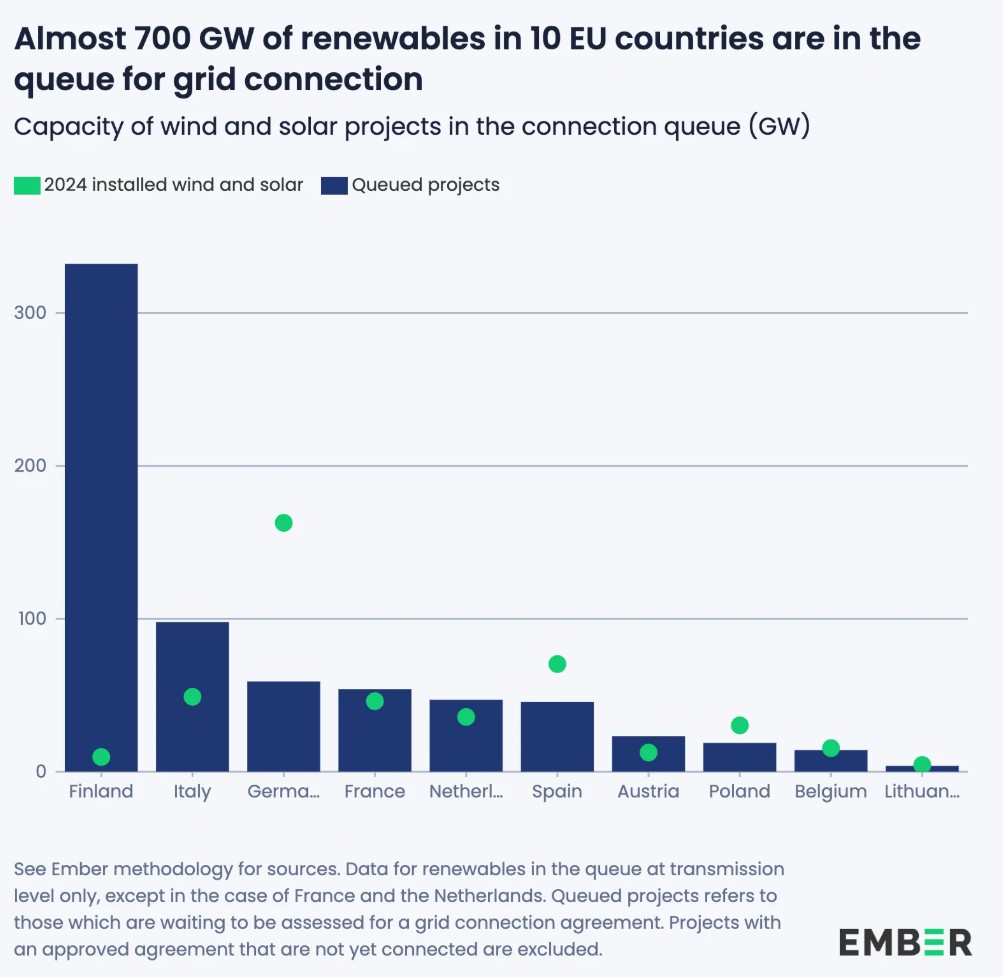
According to recent analysis by the think tank Ember, at least 120 GW of planned wind and solar capacity is facing severe delays due to limited grid connections. At the same time, around 700 GW of renewable projects is currently stuck in so-called connection queues.
Read also Global renewable capacity reaches 5.1 TW in 2025, with 692 GW added
Grid constraints threaten EU energy security
The issue affects a wide range of countries, with the most critical cases reported in Austria, Bulgaria, Latvia, the Netherlands, Poland, Portugal, Romania and Slovakia. However, very few Member States are entirely unaffected.
Crucially, the problem extends beyond large utility-scale projects. Ember estimates that up to 1.5 million European households could face delays in connecting rooftop solar systems to the grid.
This reinforces a structural reality: grid capacity is now the main bottleneck for Europe’s energy transition and a growing risk for energy security. The challenge is particularly acute as the EU faces its second fossil fuel price shock in just four years.
“Electricity infrastructure will be decisive for Europe’s ability to reduce dependence on imported fuels and expand its industrial base,” said Elisabeth Cremona, senior energy analyst. “Grid readiness is no longer a technical afterthought, it is a core indicator of economic preparedness.”
The scale of Europe’s infrastructure gap
The data highlights a systemic infrastructure deficit across the continent. The most significant shortfall is in transmission networks, where around 104 GW of capacity is missing to connect large-scale wind and solar projects.
In 10 out of 17 countries analysed, existing grid infrastructure can accommodate less than 10% of the renewable capacity planned by 2030.
At distribution level, at least 16 GW of residential solar is also at risk due to insufficient grid space, particularly in countries such as Slovenia and Denmark.
Renewable capacity stranded in connection queues
The situation is further compounded by a massive backlog of pending projects. Across just eight European countries, approximately 700 GW of renewable capacity is currently waiting in connection queues.
This means developers may face years of delays before securing grid access agreements.
Beyond delays, limited infrastructure is also driving up congestion management costs, which are ultimately passed on to consumers.
Read the full report here.