


Eight major oil companies generated €7.5 billion in windfall profits in Europe in the first half of 2026, fuelling calls for a permanent EU levy to help finance the energy transition and make electric mobility more accessible.

Oil companies’ windfall profits reach €7.5 billion in Europe
As Europe faces an increasingly severe climate emergency and Italian consumers contend with rising petrol and diesel prices, the financial results of major oil groups continue to show substantial gains. According to the latest briefing published by Transport & Environment (T&E), eight oil companies generated €7.5 billion in windfall profits in Europe in the first half of 2026 alone.
Globally, the eight groups, BP, Shell, Eni, Orlen, Repsol, OMV, TotalEnergies and Moeve, recorded €17.9 billion in windfall profits, with 42% generated within the European Union. The figures highlight how Europe’s continued dependence on fossil fuels remains a highly profitable business for the oil industry.
Geopolitical instability drives oil companies’ windfall profits
The figures reveal a striking trend. Six of the eight companies analysed more than doubled their profits in the EU in the second quarter of 2026, amid persistent instability in the Middle East and geopolitical tensions between the United States and Iran.
When crude oil prices rise as geopolitical tensions intensify, the costs of that volatility are quickly passed on to motorists at the pump, while oil companies benefit from higher margins.
Another key issue concerns how these profits are allocated. Antony Froggatt, senior director at T&E, said: “Oil giants are abandoning renewables while motorists pay the price for their record profits.”
Rather than accelerating the transition and reinvesting these substantial resources in decarbonisation, the fossil fuel industry is scaling back its commitment to renewables, while focusing on its core fossil fuel business and shareholder returns.
Poland and Denmark highlight Europe’s mobility divide
Windfall profits are not distributed evenly across Europe. T&E’s analysis shows that the highest windfall profits were recorded in Poland, followed by Spain, Germany and France.
Poland’s position is particularly significant given the country’s slow transition towards electric mobility, with battery electric vehicles (BEVs) accounting for less than 1% of the vehicle fleet. By contrast, more mature markets such as Denmark, where BEVs account for almost 19% of the fleet, show considerably greater resilience to oil price volatility.
Previous research indicates that a further escalation of the conflict in the Middle East, particularly involving Iran, could affect drivers of internal combustion engine vehicles up to five times more severely than electric vehicle owners.
A permanent windfall tax is becoming a European policy issue
Against this backdrop, the proposal for a permanent tax on oil companies’ windfall profits is increasingly being presented not as an emergency measure to be revived during periods of crisis, but as a potential structural component of European fiscal policy.
Since these windfall profits derive from revenues generated within the EU27, they could be subject to a permanent windfall tax, provided that such a mechanism is appropriately designed.
The revenues could then be directed towards a specific objective: financing the energy transition and making electric mobility accessible to a broader share of the population. This could include support for lower-income households purchasing zero-emission vehicles and investment in charging infrastructure.
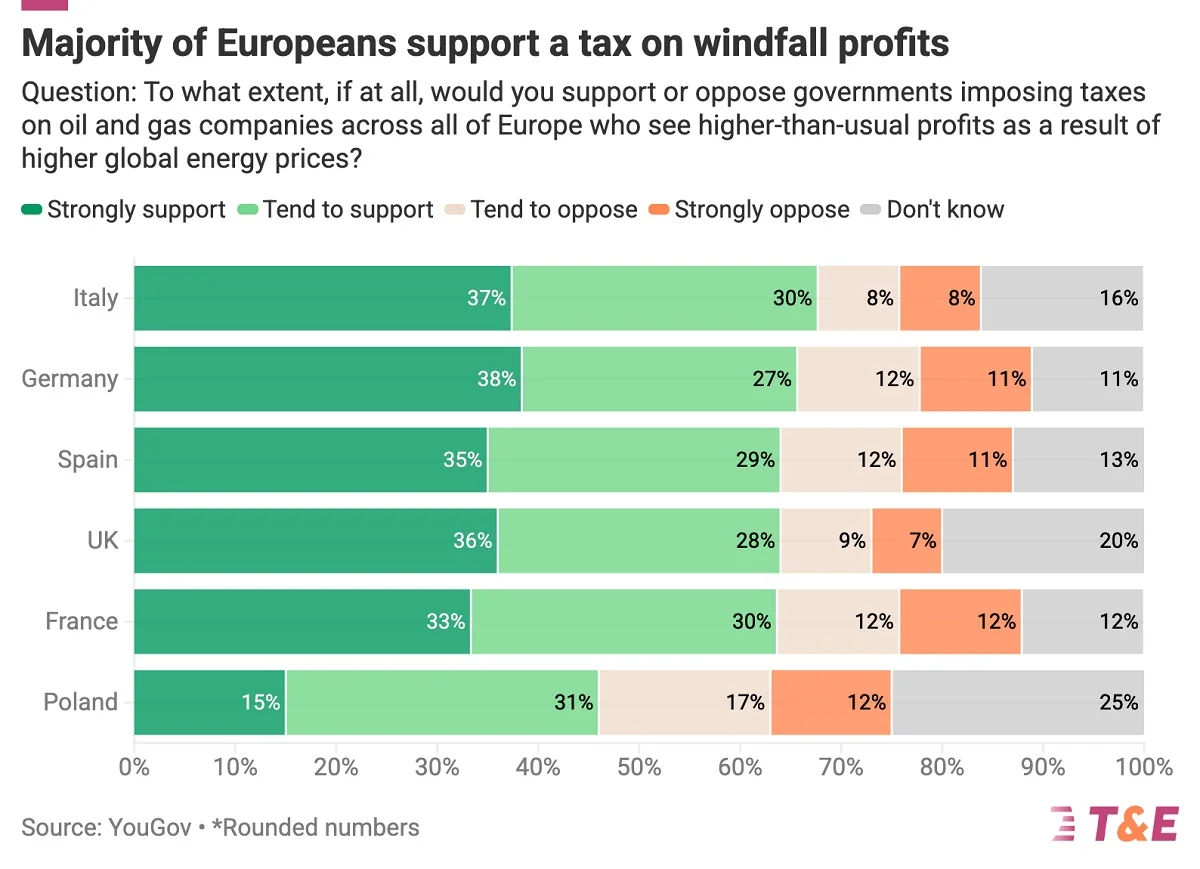
Most Europeans support taxing oil industry windfall profits
Public opinion also appears broadly supportive of taxing exceptional oil industry profits. A YouGov survey commissioned by T&E and other NGOs found that a large majority of Europeans favour a windfall tax on oil companies’ profits.
In Italy, 37% of respondents strongly support the measure, while another 30% are inclined to support it. Overall, 67% of respondents are in favour, comfortably above an absolute majority, while just 8% oppose taxing oil companies’ windfall profits.


