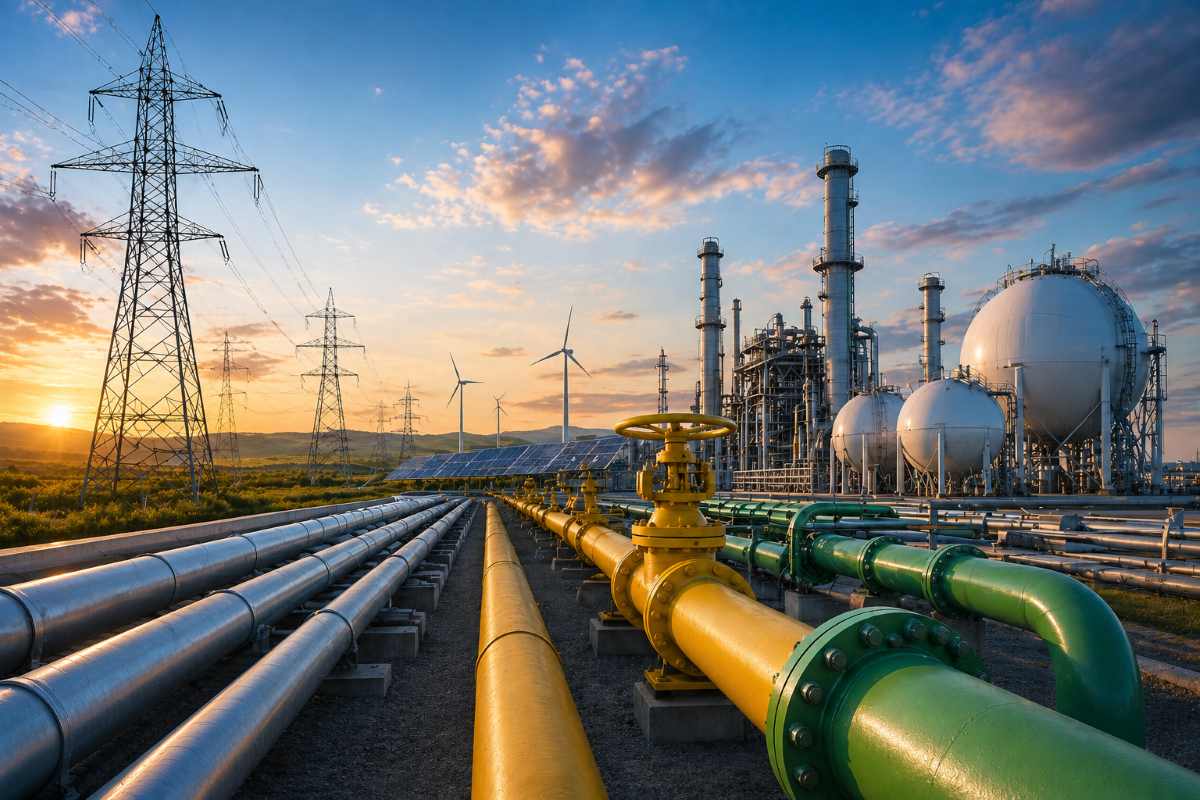
A unified framework for interconnected energy infrastructure in Europe
As energy systems become more complex, interconnected energy infrastructure Europe is emerging as a cornerstone of long-term planning. On this basis, ENTSO-E and ENTSO-G have submitted their latest Interlinked Modelling Final Report to the European Commission.
The report defines a shared methodological framework to integrate electricity, natural gas and hydrogen into energy scenario development, cost-benefit analysis and infrastructure planning.
This model acts as a strategic foundation to harmonize data, assumptions and analytical approaches, enabling consistent evaluation of supply, demand and cross-border interconnections across the European energy system.
The goal is to provide direct support to policymaking, with tangible impacts on energy security, decarbonization and renewable energy integration.
Integrating electricity, gas and hydrogen systems
The Interlinked Modelling Framework, ILM, is designed to overcome the traditional separation between energy sectors. It brings together electricity, gas and hydrogen systems into a single structure, allowing analysts to capture interactions that remain invisible in isolated models.
Key variables such as fuel and CO₂ prices, technology capacities, demand profiles and infrastructure development are aligned across sectors.
This makes it possible to build consistent and comparable scenarios. Integration is physically enabled through electrolyzers, which connect the power system to hydrogen production by converting electricity into fuel, and through gas, which supports both electricity generation and hydrogen production.
The model shows that cross-sector interactions can generate benefits that are not visible in separate analyses, particularly in terms of flexibility and renewable integration.
Planning interconnected energy infrastructure across Europe
The ILM framework is embedded in the TYNDP process, Europe’s ten-year network development plans. Energy scenarios extend to 2050 and are structured in five-year intervals.
The report highlights key scenario types developed in recent cycles, including Global Ambition, Distributed Energy and National Trends. The first follows a top-down approach aligned with European climate targets, while the second reflects a bottom-up approach based on transmission system operator data and national energy and climate plans.
Within these scenarios, demand, generation, infrastructure capacity and cross-border interconnections are defined, creating a unified analytical base where interconnected energy infrastructure Europe is treated as a single integrated system.
Cost-benefit analysis and system needs
One of the most significant elements introduced in the report is the integrated evaluation of infrastructure costs and benefits. The model uses the concept of overall socioeconomic welfare, capturing impacts across both electricity and hydrogen systems simultaneously.
This approach allows a more comprehensive assessment of infrastructure impacts, including emissions reduction, renewable integration, security of supply and overall economic efficiency.
At the same time, the model identifies infrastructure needs through simulations that highlight imbalances between demand and network capacity.
This creates a strong analytical foundation to guide investment decisions toward solutions that maximize benefits across the entire European energy system.
Multi-model architecture and data harmonization
The ILM framework is based on a multi-model architecture, where different tools are used at various stages while maintaining consistency in data and assumptions.
Standardization applies to key elements such as energy and CO₂ prices, generation and storage capacity, demand profiles and interconnection forecasts. This harmonization enables direct comparison of scenarios and projects, ensuring transparency and reliability.
The result is an analytical system capable of integrating data from multiple sectors, reducing methodological discrepancies and improving the overall quality of analysis.
A roadmap for interconnected energy infrastructure Europe
The report also outlines a roadmap for future development.
In the short term, efforts focus on improving data quality and refining the representation of hydrogen systems. By 2030, deeper integration between energy sectors and further methodological alignment are expected.
In the long term, beyond 2030, the goal is to achieve fully integrated planning, incorporating additional energy carriers and supporting an increasingly interconnected system.
This pathway is aligned with Europe’s climate neutrality targets and the growing complexity of the energy landscape.
A paradigm shift in European energy planning
The report highlights a fundamental shift in energy planning. The focus is no longer on individual energy carriers, but on an integrated system where interconnected energy infrastructure Europe becomes the central reference for strategic analysis.
The ILM framework is designed to capture cross-sector dependencies and optimize investments, offering stakeholders advanced tools to assess economic, environmental and social impacts.
In this context, the framework strengthens the analytical foundation of European planning, helping make the energy transition more coordinated and effective.