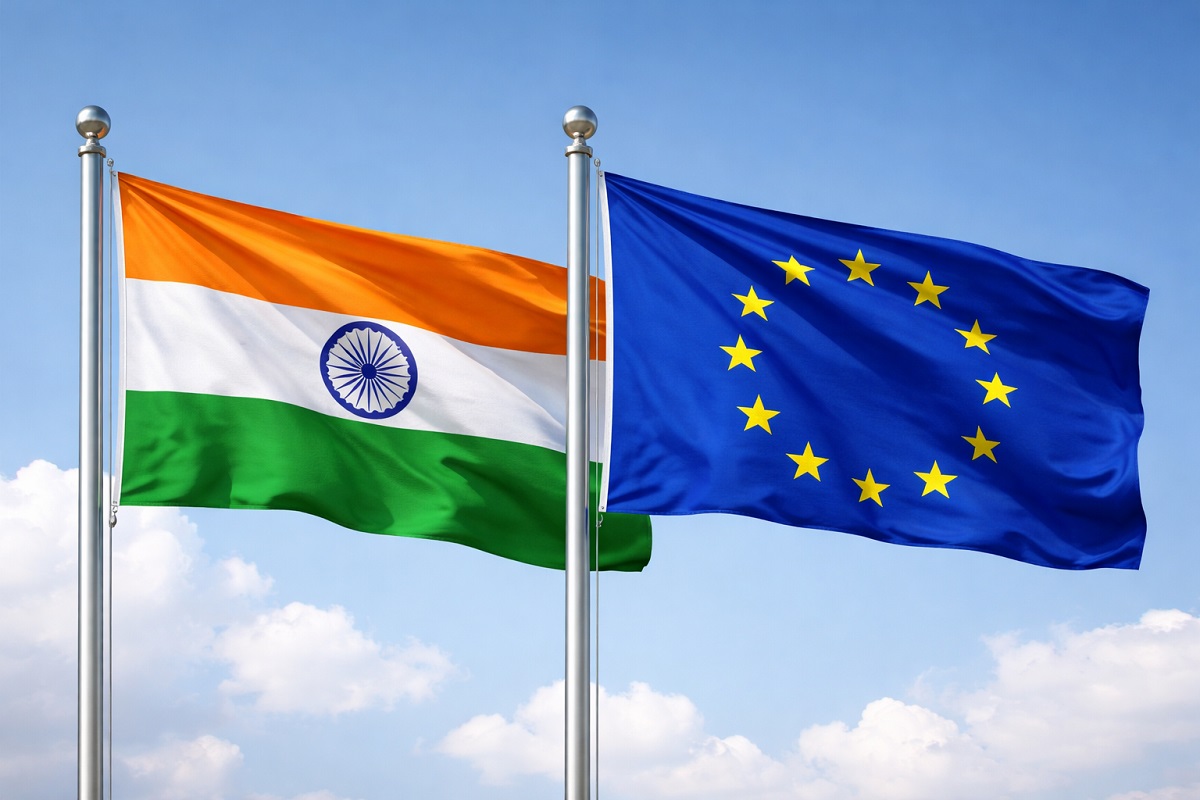
The India-Europe agreement reshapes trade and industry
Described by European Commission President Ursula von der Leyen as “the mother of all trade agreements”, the India-Europe agreement was signed in New Delhi alongside Indian Prime Minister Narendra Modi.
The commercial and industrial deal will eliminate or reduce customs duties on 96.6% of goods exported from the European Union to India. The partnership connects markets representing around two billion people and is expected to generate estimated annual savings of approximately €4 billion for European companies.
At a time when global supply chains are being reconfigured, the agreement strengthens the EU’s diversification strategy beyond traditional partners.
Tariff cuts and trade expansion
The EU and India already exchange goods and services worth more than €180 billion annually, supporting nearly 800,000 jobs within the EU. The agreement is expected to double EU goods exports to India by 2032.
Following the rise in tariffs introduced by the United States in recent years, Europe has sought alternative high-growth export markets, first with Mercosur countries and now with India. The India-Europe agreement reflects this broader geopolitical and economic repositioning.
More than 6,000 European companies are already active in India, supporting around 3.7 million jobs. According to von der Leyen, many more are expected to enter the market once the agreement enters into force.
Automotive sector at the centre
One of the most significant changes concerns the automotive sector, historically protected in India by high import duties.
Tariffs on fully assembled vehicles will gradually fall from 110% to 10% over ten years, with an immediate reduction to 35%. A yearly export quota of 250,000 vehicles will benefit from preferential treatment, including 160,000 internal combustion engine vehicles and 90,000 electric vehicles.
For completely knocked-down kits assembled locally, duties will be reduced from 16.5% to 8.25% within a quota of 75,000 units. The spare parts and components sector will be fully liberalised, creating new opportunities for European suppliers.
In exchange, India secured a strategic industrial concession: the right to export 1.6 million tonnes of steel per year to the EU at zero tariffs.
Broader sectoral impacts
Tariffs on machinery, chemicals and pharmaceuticals will largely be eliminated. The agri-food sector will also benefit from substantial reductions. Average duties of 36% on European products will fall significantly, with wine tariffs dropping from 150% to 75% and eventually to 20%, olive oil reduced from 45% to zero within five years, and processed foods such as bread and confectionery seeing duties of up to 50% removed.
Sensitive agricultural sectors including beef, poultry, rice and sugar will remain protected.
Security and geopolitical dimension
The India-Europe agreement is not limited to trade. European Council President António Costa and High Representative Kaja Kallas highlighted the inclusion of a defence and security pillar for the first time.
“In a multipolar and changing world, the EU and India stand as reliable strategic partners,” Costa stated. Cooperation will extend to maritime security in the Indo-Pacific, counter-terrorism and cyber defence, reducing strategic dependencies on third parties.
Next steps
The legislative process is not yet complete. After legal review and translation, the text must be approved by qualified majority in the Council of the EU and receive consent from the European Parliament.
Notably, ratification by individual national parliaments is not required, potentially accelerating entry into force by the end of 2026.