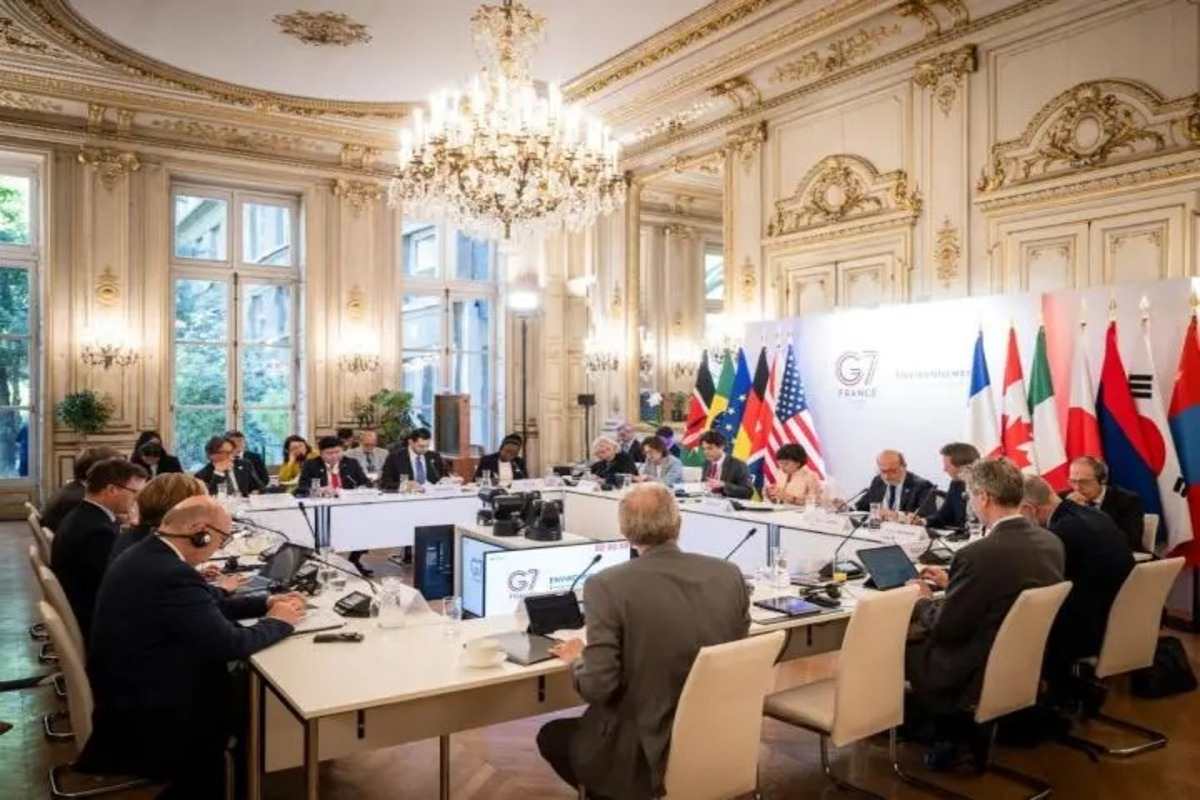
The meeting of G7 Environment Ministers in France concluded with the host government defending the “pragmatic” decision to exclude climate change from the agenda, in order to avoid a direct clash with the United States.
Despite the overwhelming scientific evidence, Donald Trump has repeatedly denied climate change, describing it as a hoax, and has withdrawn the United States from several international bodies tasked with climate protection. By excluding the issue from the formal agenda of last week’s meeting in Paris, the French government followed a “more pragmatic approach”.
Avoiding a direct confrontation
This approach was intended to avoid a direct confrontation with the US and the risk that some participants might leave the negotiating table, as explained by France’s Environment Minister, Monique Barbut. “No one wanted a confrontation and everyone felt relieved that this G7 meeting took place under good conditions. All were willing to work on widely shared issues. If I had addressed the issue head-on, there would have been no G7,” Barbut told journalists.
The talks covered topics such as the protection of biodiversity and oceans, water resource management and combating desertification. “I am satisfied with the outcome. I asked to focus on points of convergence,” the minister concluded.
Biodiversity funding initiative
France is leading an initiative to increase public and private funding for nature protection. The objective is to raise nearly €600 million for more than 100 national parks in 22 African countries. Around €400 million is expected to come from philanthropic sources, particularly from US billionaire Rob Walton.
However, Jean Burkard of WWF France told France24 that any new funding should be considered additional and not as compensation for possible cuts to existing state budgets for nature protection.
G7 environment meeting France results: seven declarations for environmental security
In a global context marked by increasing international tensions and the weakening of multilateralism, the French government claimed diplomatic success for the summit, the result of a deliberate choice by the French presidency: preserving G7 unity and delivering tangible progress where possible.
Two days of discussions in Paris led to the adoption of seven declarations on key strategic priorities:
- Framework declaration: a comprehensive document bringing together all agreements reached
- Security and environment: placing the link between desertification, land degradation, water scarcity and societal destabilisation at the top of the international agenda
- Biodiversity and finance: launch of the Nature and People Finance Alliance to mobilise public and private capital
- Oceans: two separate declarations, one with concrete commitments to improve the management of marine protected areas, the other to strengthen the fight against illegal, unreported and unregulated fishing
- Water and environmental health: strengthened cooperation to address pressure on resources and emerging forms of pollution, including PFAS and microplastics
- Adaptation and resilience: mobilisation of states to enhance resilience in the real estate sector and protect local communities from natural disasters
Ecology as a pillar of sovereignty
The French government considers ecology a central issue in power balances, stability and security. Paris intends to continue discussions on these topics in upcoming international meetings and initiatives led by France in the coming weeks, including one focused on reducing methane emissions at a high-level event scheduled for 4 May.
G7 in France: absences and diplomatic tensions
All other G7 members (Italy, Canada, Japan, Germany and the United Kingdom) sent their environment ministers to Paris. Washington, however, delegated a lower-level representative, Usha-Maria Turner, a deputy figure within the US Environmental Protection Agency.
Criticism from activists
Not everyone supported France’s strategy of appeasement. Despite institutional optimism, the decision sparked strong criticism. Gaia Febvre of the Climate Action Network told AFP: “A G7 that moves at the pace of the United States cannot claim to respond to the crises of this century. By yielding to pressure, the group weakens collective action and gives up its potential leadership role.”
The talks took place just days before a summit in Colombia, where more than 50 countries will gather for the first global conference dedicated to the phase-out of fossil fuels, the main cause of global warming.