European Green Deal progress reveals growing gaps across climate and sustainability targets
How far has the European Green Deal advanced since its launch in 2020 to make the European Union climate neutral by mid-century? According to researchers at the European Commission’s Joint Research Centre (JRC), the answer depends on perspective. The glass is either half full or half empty.
While substantial progress has been made toward many objectives, a significant share of the bloc’s targets has effectively stalled. In some areas, Europe is even moving backward.
For Italy, these findings come as little surprise. The country has become one of the leading voices questioning key elements of the Green Deal, gradually challenging major directives and regulations. From its opposition to the Emissions Trading System (ETS), to delays in implementing the Energy Performance of Buildings Directive, from resisting the phaseout of internal combustion engine vehicles to remaining silent on the revised Energy Efficiency Directive, Rome has repeatedly pushed back against the EU’s climate agenda. Its latest reversal came with the decision to postpone the national coal phaseout until 2038.
Italy, however, is far from alone.
Support for weakening the European Green Deal has frequently come from several Eastern European countries, particularly Poland, which has long opposed the EU’s 2050 decarbonization target. France and Germany have also repeatedly sought to reshape climate policies to better align with their national industrial priorities. The underlying argument has remained largely the same: protecting industrial competitiveness and shielding citizens from the perceived costs of what critics describe as “ideological policies.”
The result is a Green Deal that no longer enjoys the political momentum it once did. What European Commission President Ursula von der Leyen famously described as Europe’s “man on the Moon moment” now looks more like its first step into lunar orbit.
Researchers at the Joint Research Centre examined 44 policy documents published between 2019 and 2024, assessing progress across 154 measurable targets covering climate ambition, clean energy, the circular economy, biodiversity, pollution and sustainable mobility.
Their findings show that only 32 targets, or 21%, are currently on track. Another 64 targets, representing 41%, require faster implementation. Fifteen targets, equal to 10%, show either no progress or clear signs of regression, while data remain unavailable for the remaining 28%.
Where is Europe losing ground? The setbacks span multiple sectors.
On climate action, the European Union committed to increasing carbon removals from forests and soils to reach -310 MtCO2e by 2030. Current trends, however, are moving in the opposite direction. Human activities, combined with natural disturbances such as wildfires and pest outbreaks, are reducing the carbon sequestration capacity of forests and soils.
The circular economy presents another challenge. The circular material use rate remains essentially unchanged from 2010 levels, despite the European Green Deal’s objective of doubling it by 2030. Europe has also failed to reduce the environmental and climate footprint of its consumption, which has actually increased, while total waste generation continues to rise instead of declining.
Biodiversity indicators are equally concerning. Populations of common farmland birds continue to decline, as do grassland butterflies, one of Europe’s essential pollinators. Meanwhile, a significant share of protected marine habitats remains in either unfavorable or unknown conservation status.
Recent years have also brought setbacks in food security. Food insecurity has increased across Europe, while overweight and obesity rates have continued to rise slightly instead of falling. At the same time, the agrifood sector has lost roughly 25% of its workforce over the past decade.
These figures mainly reflect previous years, and it is theoretically possible that implementation accelerated during 2025. Yet given the delays many Member States continue to accumulate in transposing EU legislation, confirmed by the latest infringement procedures launched by the European Commission, there is little reason for optimism.
What many governments continue to overlook is that scientific evidence increasingly points in the opposite direction. The ecological transition promoted through the European Green Deal progress agenda is itself a cornerstone of Europe’s long-term competitiveness. Accelerating decarbonization, technological innovation and strategic autonomy represents the most effective path for preserving economic prosperity, social cohesion and public health across the European Union.
A second Joint Research Centre study provides further evidence supporting this conclusion.
The analysis begins with recent climate disasters, including the devastating floods that struck Valencia in October 2024, causing approximately 237 deaths, about 70% of all flood-related fatalities recorded in Europe that year. If Europe abandons its climate ambitions, the impacts it is already experiencing would become dramatically more severe.
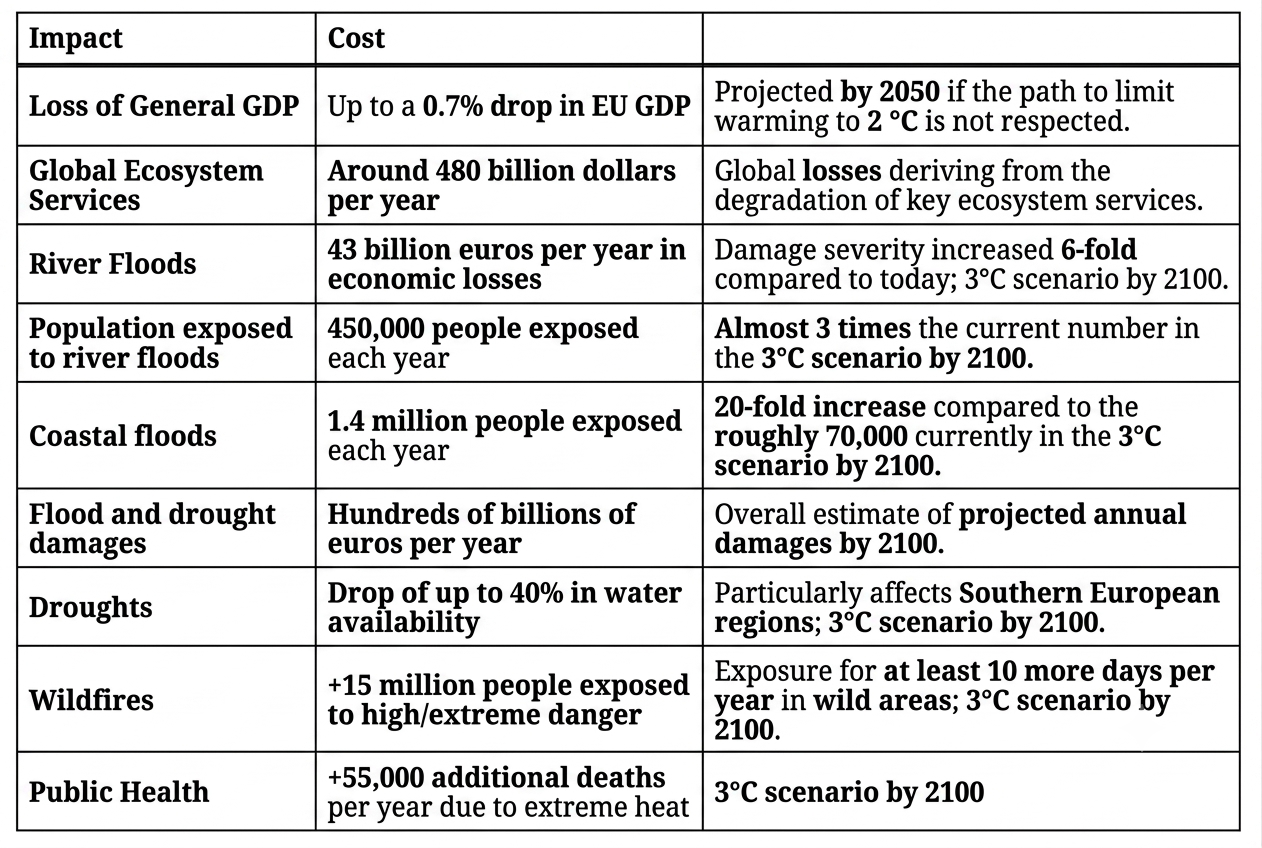
The report describes the consequences of a 3°C to 4°C global warming scenario as the “cost of inaction.”
By 2100, temperature-related deaths could increase by approximately 55,000 additional fatalities, driven by more frequent heat-related mortality and an aging population. Another 15 million Europeans living near rural areas could face high to extreme wildfire risk for at least ten days each year. Annual exposure to coastal flooding would rise from roughly 70,000 people today to 1.4 million, a twentyfold increase.
Water availability across southern Europe could decline by as much as 40%, while river flood damages would increase sixfold, reaching €43 billion per year under a 3°C warming scenario. Overall, these impacts would translate into economic losses equivalent to at least 0.7% of the EU’s annual GDP by 2050.
By contrast, the report argues that investing in nature restoration and climate action generates substantial economic returns. Annual investments of around €5.8 billion in protected areas, for example, could deliver benefits worth up to €300 billion per year.
The researchers also emphasize that “dependence on fossil fuels and critical raw materials undermines the EU’s competitiveness and resilience, particularly during periods of geopolitical instability.”
Recent events reinforce that conclusion.
The spike in global natural gas prices triggered by the Middle East conflict cost the European Union an additional €13 billion between March 1 and mid-April 2026 compared with the same period and import volumes one year earlier. The situation could have been even worse. Newly installed renewable energy capacity partially offset higher fuel costs, avoiding approximately €29 billion in imported fossil fuel expenditures.
“At the same time, revenues from environmental policies could finance building renovations and the transition to low-carbon heating systems, stimulating both the economy and public health.”