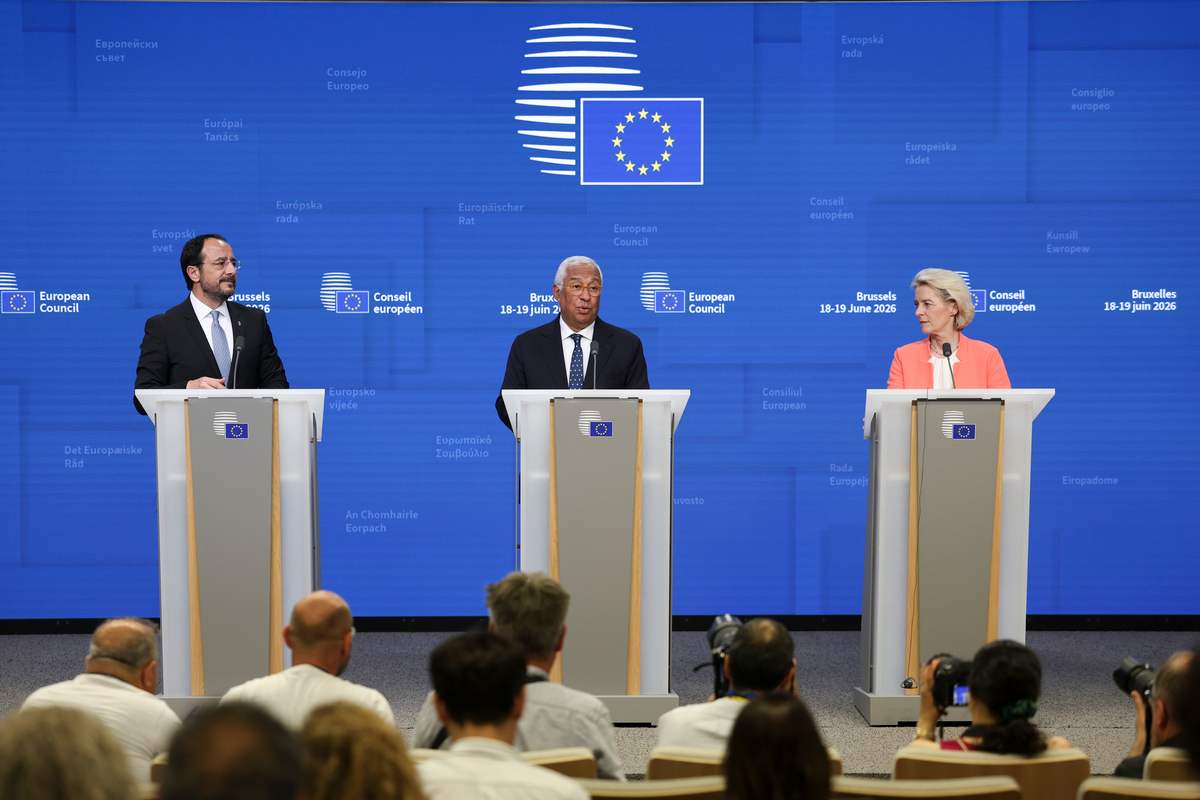
EU China trade strategy shifts towards supply chain diversification
The European Commission is preparing a new mechanism that would require EU companies to diversify their sources of strategic supplies and reduce excessive dependence on China. According to Commission President Ursula von der Leyen, Brussels intends to introduce the instrument even if businesses are already voluntarily implementing risk-reduction strategies.
The announcement follows last week’s G7 summit, where leaders discussed structural industrial overcapacity and its impact on global economic imbalances.
“Over the past five years, imports from China into the European Union have increased by 45%,” von der Leyen said. “Last year, the European Union recorded its largest-ever trade deficit with the People’s Republic of China, reaching €360 billion, almost €1 billion every day. For the first time, every Member State recorded a trade deficit with China. We are not simply talking about low-cost imports. We are facing industrial overcapacity that is eroding our manufacturing base. This situation is simply unsustainable.”
De-risking, not decoupling
The Commission President reiterated that European leaders broadly support a strategy based on diversification rather than economic separation.
“Our discussions showed clear support for the strategy of diversification and de-risking in our economic relations,” she said. “On the one hand, we must avoid dependencies that could be used as instruments of geopolitical pressure. That is why we are accelerating de-risking, not decoupling. On the other hand, we will continue protecting our market against unfair practices.”
Von der Leyen also stressed that the European Union has already equipped itself with an extensive range of trade defence instruments.
“Over recent years, Europe has developed a broad arsenal of trade instruments. We must now use them more proactively and strategically to defend European interests. The Commission will also work on new tools, including a diversification mechanism.”
EU China trade tensions remain on hold
Meeting in Brussels immediately after the G7 summit, EU leaders opted to continue engaging with major trading partners on global macroeconomic imbalances rather than immediately escalating trade measures.
For now, Brussels appears to have postponed a direct commercial confrontation with China, partly because Member States remain divided over how to respond to the growing flow of low-cost Chinese imports that has weakened parts of European manufacturing.
Instead, European leaders asked the Commission to assess the existing EU trade defence toolbox and, where necessary, consider developing additional instruments.
Chinese Commerce Minister Wang Wentao is expected to travel to Brussels at the end of June for talks with European Commissioner for Trade Maroš Šefčovič.
“Everyone agrees that measures are needed to reduce our dependency,” Belgian Prime Minister Bart De Wever told POLITICO after the summit. “And the subsidies granted in China are not fair. We have to respond to this situation. The Commission intends to propose measures, and we will continue discussing them.”
New trade instruments under consideration
Among the options being examined is a possible mechanism inspired by the United States’ Section 301 trade measures, which Washington has previously used against both the European Union and China.
The proposal was first raised last month by French President Emmanuel Macron. Although concerns have been expressed about its compatibility with international trade rules, several Member States are reportedly showing interest in exploring a similar approach as part of the EU’s future trade strategy.