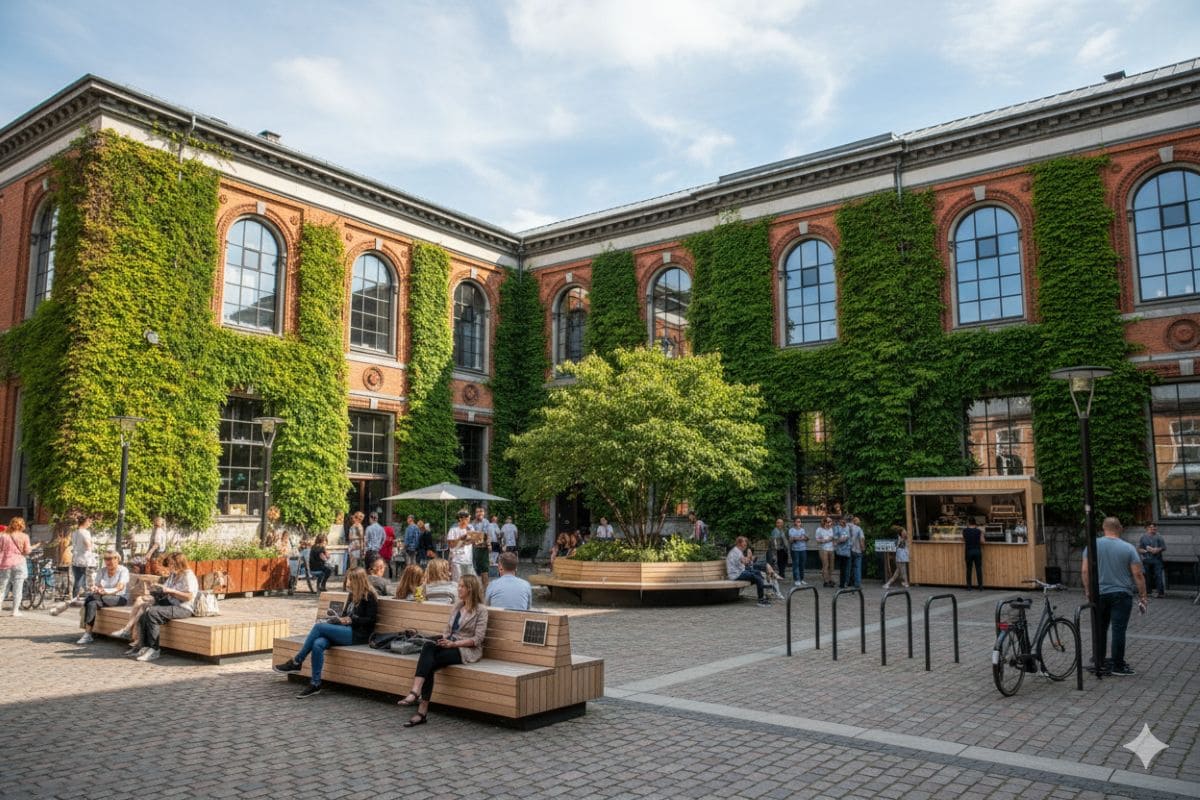
The New European Bauhaus confirms its role in the European Green Deal
Since 2021, the New European Bauhaus has embodied the cultural and design dimension of the European Green Deal, connecting architecture, innovation and social inclusion. Each year, the initiative rewards projects that best interpret its long-term vision and objectives.
In the 2025 edition, 22 proposals were crowned across four thematic categories: reconnecting with nature, regaining a sense of belonging, prioritising places and people most in need, and shaping a circular industrial ecosystem.
Projects were divided into Champions, completed interventions with tangible results, and Rising Stars, concepts and prototypes developed by young people under 30.
The award format confirms the structure seen in the 2024 edition, which focused on urban regeneration and Ukrainian reconstruction. The 2025 edition broadens its scope further, with a stronger emphasis on housing challenges and local communities.
The four categories and leading projects
Among the Champions, notable projects include Green Axes and Squares, the Austrian cooperative die HausWirtschaft integrating housing, workspace and care services, and the Lithuanian project HempForma, which revives hemp as a circular material for acoustic panels. In Ukraine, Promprylad transformed a former factory into a hub for innovation and social cohesion.
In the Rising Stars category, selected projects include Pollino in Hungary, which transforms urban signage into habitats for pollinators, an Estonian initiative co-designing community courtyards with recycled materials, and the Italian UN_SKIN project experimenting with bio-based alternatives to leather.
At the Brussels ceremony, Commission President Ursula von der Leyen stated: “Our objective is to make housing more affordable, sustainable and of better quality. A home is not just walls and a roof. It is about security and belonging.”

Sustainable housing and the special award
Addressing the housing crisis and shortage of homes led to the introduction of a special award for the first time: the NEB Affordable Housing Prize. Four completed projects in Denmark, France, Germany and the Netherlands were recognised. These initiatives demonstrate how economic accessibility, energy efficiency and social inclusion can be combined.
This focus on sustainable housing represents a direct response to the housing emergency affecting many Member States, reinforcing the role of the New European Bauhaus as a policy lever supporting EU urban strategies.
Small municipalities and local transition
Another innovation in 2025 was the New European Bauhaus Boost for Small Municipalities, involving 20 small European towns. From Greek and Spanish villages to Italian and Nordic communities, local authorities demonstrated that the ecological transition is not limited to major cities but also concerns smaller centres capable of launching environmental regeneration and social inclusion projects.
Supported by the European Parliament, the initiative aims to lower initial barriers that often prevent smaller administrations from starting innovative projects.
From the Green Deal to local implementation
Launched in 2021 during Ursula von der Leyen’s State of the Union address, the New European Bauhaus Prize has grown to involve 2,000 members and nearly 500 projects. Over five years of awards, more than 5,700 applications have been received, 94 projects have been recognised and over €2 million in support has been distributed.
The link with the European Green Deal has become increasingly evident. Awarded projects do not merely experiment with new aesthetic and technological forms but implement replicable models of urban regeneration, circular construction and inclusive housing.
Looking ahead, the Commission has launched the call for the New European Bauhaus Festival 2026, to be held from 9 to 13 June in Brussels. Architects, companies, local authorities and citizens may apply until 15 October 2025 for participation in the fair and “fest” section, while the deadline for satellite events is 31 December 2025. A student design competition has also been opened for the official 2026 trophy.