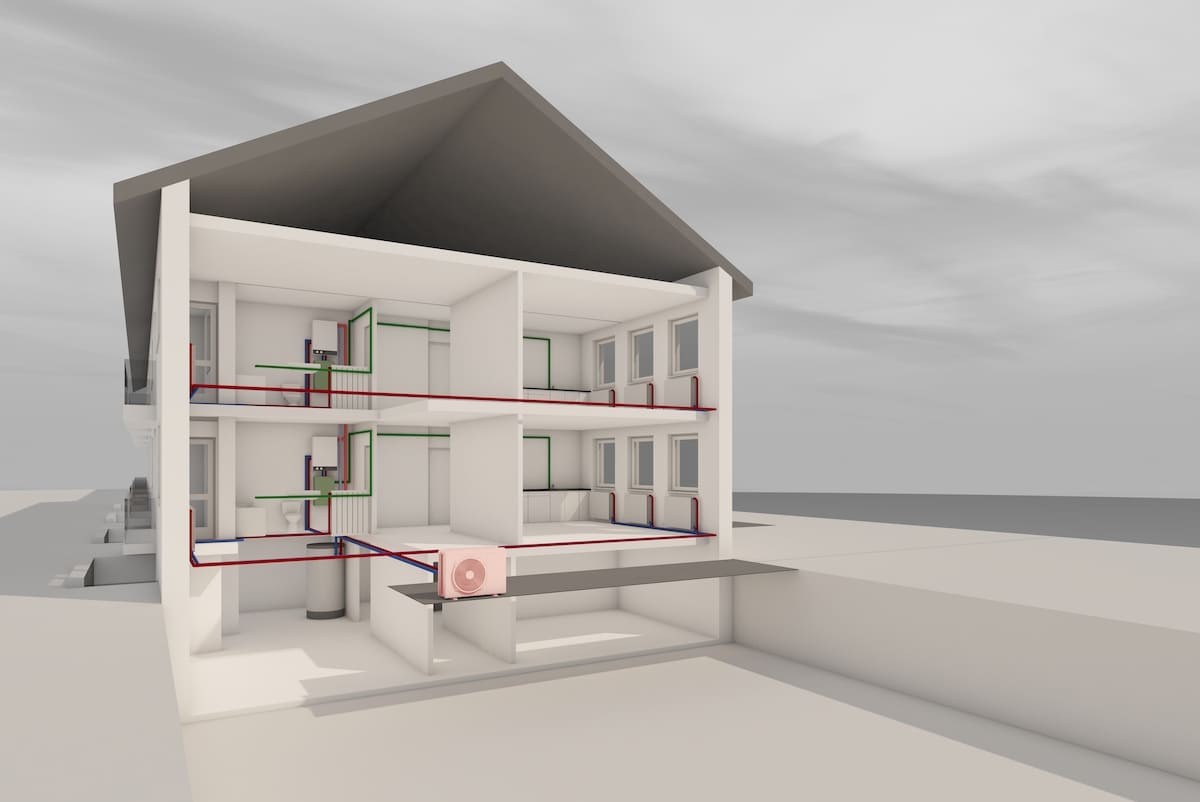
Multifamily heat pumps offer a tailored route to replacing central gas heating
Across many European cities, central gas boilers continue to provide heating for thousands of apartment buildings. According to researchers at the Fraunhofer Institute for Solar Energy Systems (ISE), these systems could be replaced with multifamily heat pumps using propane (R290), but only if every installation is specifically designed to match the building’s technical requirements.
The findings come from the LC R290 research project, launched in 2023 to standardise heat pump solutions capable of replacing gas and oil heating systems across different building types. The project focuses on propane (R290), a natural refrigerant that combines excellent thermodynamic performance with a very low global warming potential.
Building-specific design is essential for multifamily heat pumps
Researchers found there is no universal solution suitable for every apartment building. Successful electrification depends on a careful assessment of factors such as building size, available installation space, heat demand, hydraulic layout, thermal storage and heat distribution.
“Because of the wide range of challenges, including the availability of suitable heat sources and limited installation space, we could not rely on a single technological solution,” explained Björn Nienborg, project coordinator at Fraunhofer ISE. “Instead, we developed several applicable concepts. The key is a building-specific design that integrates the heat pump, thermal storage, hydraulics, control systems and heat distribution.”
Europe’s heat pump market continues to expand
The research comes as Europe’s heat pump market continues to recover. According to the latest figures from the European Heat Pump Association (EHPA), sales increased by 13% in 2025, reaching 2.9 million units across 21 European countries and saving approximately 2.5 billion cubic metres of natural gas. Europe now has an installed base of 29.3 million heat pumps.
Germany recorded the strongest year-on-year growth, while Italy ranked second in Europe for new heat pump sales, with 423,000 units sold in 2025, behind only France with 528,000 units.
The European Commission’s new Electrification Action Plan is expected to provide additional momentum for the sector, increasing demand for solutions capable of decarbonising apartment buildings and other multifamily properties.
Prototype multifamily heat pumps improve efficiency while reducing refrigerant use
For outdoor central heating replacements, Fraunhofer researchers developed a prototype that reduces the refrigerant charge by 20% compared with similar commercial heat pumps while increasing efficiency by 15%.
For indoor installations, the team designed a compact propane-based sole-split water-to-brine heat pump. In this configuration, the outdoor unit functions only as an air-to-brine heat exchanger, while the compressor and the refrigerant circuit remain inside the building.
Although this solution slightly reduces seasonal efficiency compared with outdoor monobloc units or geothermal systems because of the additional heat exchange stage, it offers greater installation flexibility for buildings with space constraints.
Propane safety remains a key consideration for multifamily heat pumps
Despite its environmental advantages and excellent thermodynamic properties, propane (R290) is highly flammable and heavier than air, meaning leaked gas can accumulate near the ground rather than dispersing naturally.
To address these challenges, the research team developed a standardised refrigeration circuit containing only 150 grams of propane for decentralised units, improving safety during both installation and operation.
Researchers also carried out more than 100 experimental tests covering five different safety concepts to evaluate possible indoor gas leaks during installation.
For larger centralised systems, which require higher refrigerant charges, dedicated ventilation strategies remain necessary. The study validated the effectiveness of a mechanically ventilated enclosure with external exhaust, while also assessing two additional concepts, known as the chimney and drainage approaches, which will be investigated further.
Software tools aim to simplify future heat pump projects
Fraunhofer ISE is now integrating the results of the LC R290 project into its new MAMMUT initiative, which aims to develop software supporting the design and decision-making process for multifamily heat pumps.
According to the institute, the tool will help HVAC installers design building-specific heat pump systems while generating project quotations directly from the planning process, reducing both engineering time and installation complexity.