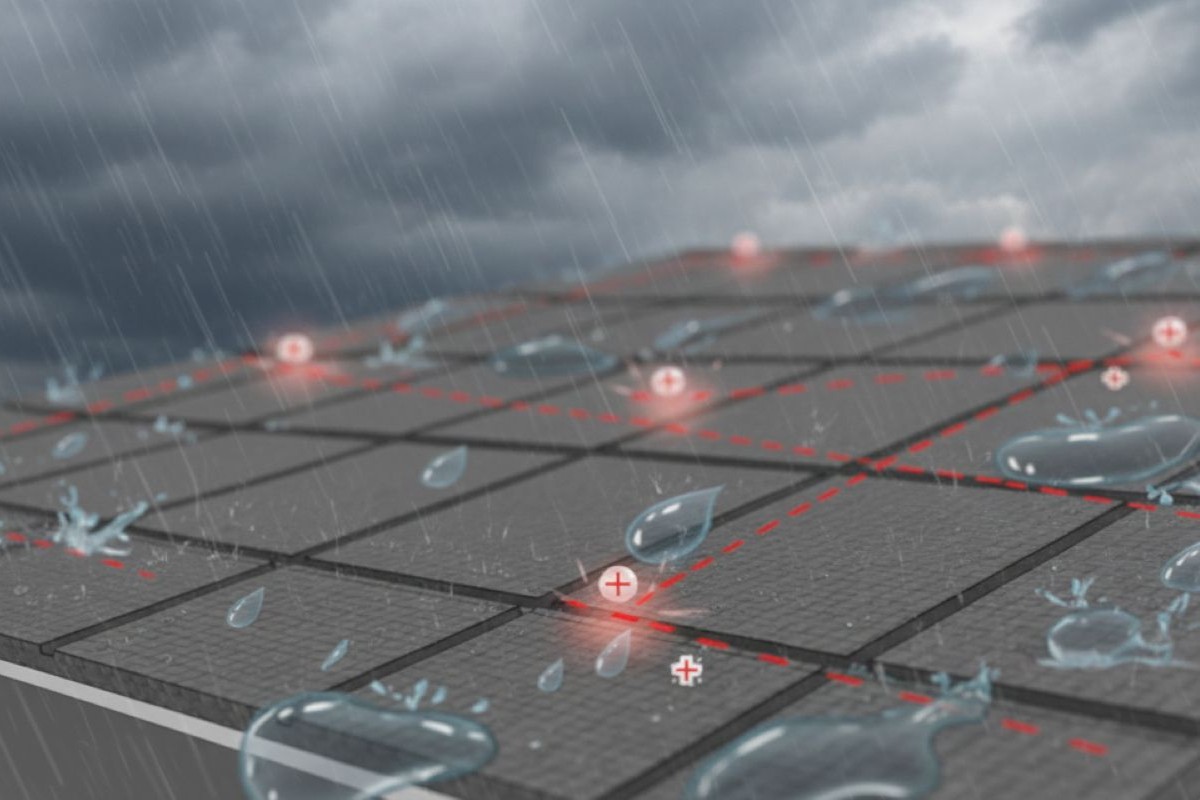
How the new device generates energy from rain
A research team at UNIST (Ulsan National Institute of Science and Technology) has presented an innovative solution in the field of droplet-based electricity generators (Droplet-based Electricity Generator – DEG).
Unlike traditional systems, this device makes it possible to generate energy from rain and at the same time autonomously activate rainwater collection and storage systems without external power supply.
Developed by Professor Young-Bin Park of the Department of Mechanical Engineering at UNIST, the system uses a carbon-fibre-reinforced superhydrophobic polymer (CFRP) which, when installed on building roofs, converts the impact of raindrops into usable electrical signals.
An evolution of the triboelectric effect
The physical principle behind generating energy from rain is the triboelectric effect. This phenomenon occurs when two different materials, at least one of which has insulating properties, come into contact or rub against each other. The interaction causes a transfer of electrons from one surface to the other, generating electrostatic charge and a resulting potential difference.
The DEG system developed at UNIST operates on a similar principle.
When a raindrop strikes the superhydrophobic surface of the device, charge transfer occurs between the liquid and the solid material. Because of the surface’s water-repellent properties, the droplet does not adhere but quickly detaches and rolls away. This dynamic separation induces electron flow through the carbon fibres embedded in the polymer, converting the mechanical energy of impact into electric current almost instantaneously.
High performance in harsh environmental conditions
A distinctive feature of the system is its ability to generate energy from rain even in demanding environmental conditions. Its reliability is linked to the CFRP design, carbon-fibre-reinforced polymer, which protects the device from corrosion caused by humidity and pollution. This represents an advantage over conventional metallic generators, ensuring greater long-term durability.
Laboratory tests confirmed the system’s potential. A single raindrop, with a volume of around 92 microlitres, generated up to 60 volts. To demonstrate scalability, researchers connected four units in series, successfully powering a module of 144 LED lights for a short period.
Real-world applications and intelligent monitoring
To validate the technology, the research team installed the device on rooftops and drainage pipes in real-world settings. As rainfall intensity increases, electrical signals become stronger and more frequent. The system is therefore able to produce energy from rain while also functioning as an intelligent sensor.
The device can distinguish between light, moderate and heavy rainfall, autonomously activating drainage pumps when required.
“This technology allows urban infrastructure to monitor rainfall and respond to flood risks using only the energy generated by the rain itself,” said Professor Park. “In the future, the system could be integrated into mobility sectors, including vehicles or aircraft, where carbon-fibre composites are already widely used.”
The research was published in the journal Advanced Functional Materials.