Waste heat recovery turns discarded heat into cooling
Large volumes of low-temperature heat produced by data centres and industrial facilities are currently difficult to put to productive use. A new technology developed by the Korea Institute of Machinery and Materials (KIMM) could help change that, opening up another route for waste heat recovery and turning otherwise discarded thermal energy into a source of cooling.
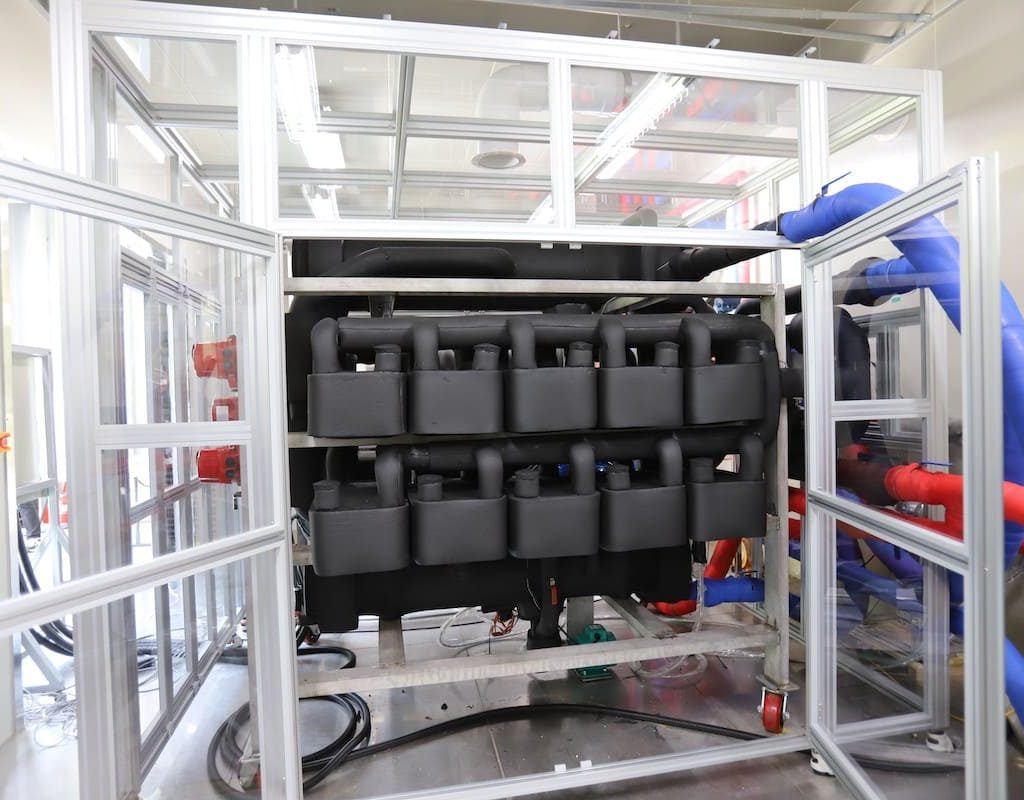
A research team led by Dr Young Kim has developed a chemical adsorption heat pump designed to use low-temperature heat while delivering exceptionally high cooling capacity.
Understanding the significance of the innovation, however, requires a closer look at how this type of heat pump works.
How chemical adsorption heat pumps work
This is not a conventional heat pump. Instead, the system relies on chemical adsorption, replacing the electrically powered mechanical compressor normally used to compress and circulate refrigerant with reversible, heat-driven chemical reactions.
The process consists of two main phases:
- an adsorption phase, during which gaseous refrigerant chemically binds to a solid adsorbent, generally halide salts such as calcium chloride or magnesium chloride, releasing useful heat;
- a desorption phase, during which thermal energy is supplied to break the chemical bond and evaporate the refrigerant, which consequently absorbs heat from its surroundings.
The performance of this technology generally increases with the temperature of the heat source. This is why a significant share of research into chemisorption heat pumps has focused on systems operating with heat sources above 65-70°C.
The challenge is that much of the waste heat generated by industrial processes and other facilities is available at substantially lower temperatures, levels traditionally considered too low to be useful. Finding effective ways to harness this thermal resource could therefore significantly expand the potential of waste heat recovery.
KIMM’s new chemical adsorption heat pump is designed to address precisely this problem.
Waste heat recovery with a 10 kW Korean prototype
For the 10 kW prototype developed by the researchers, the adsorption bed was completely redesigned, with ammonia used as the refrigerant.
The innovation goes further. Most conventional adsorption systems rely solely on alternating heating and cooling cycles. In the new system, the researchers integrated an electrochemical compressor with no moving mechanical parts, allowing the reaction to proceed more rapidly and continuously while doubling efficiency compared with competing technologies.
The new heat pump achieved a specific cooling capacity of 346.5 W/kg.
“This is more than twice the performance of comparable international technologies and represents a world-leading level of performance,” KIMM said.
According to the researchers, the technology could be integrated into air-conditioning and cooling systems for data centres, factories and commercial buildings, providing a new application for low-temperature thermal energy that would otherwise go unused.
Data centres could turn excess heat into a cooling resource
The technology is particularly relevant to data centres, where cooling represents a critical component of energy management. By making low-temperature waste heat recovery more effective, the system could allow part of the heat generated by these facilities to be reused to support their cooling requirements.
“We are currently conducting demonstration tests with a 10 kW prototype,” Kim said. “Based on the results, we plan to continue research to refine the technology and make it available for field demonstration.”