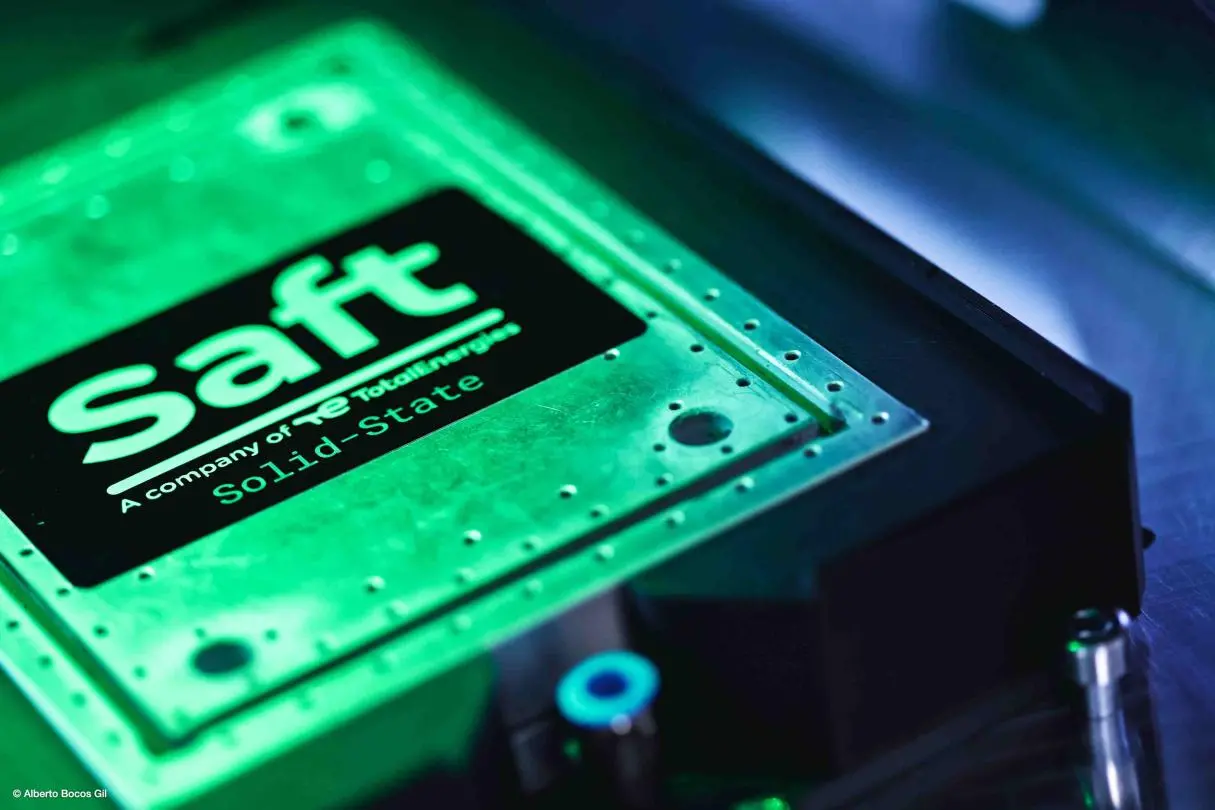
Solid-state batteries in France: Saft targets aviation and space
Solid-state batteries in France are gaining momentum as Europe seeks to establish a stronger position in a market still largely dominated by Asian manufacturers, particularly China. Offering significantly higher energy density than conventional lithium-ion batteries, solid-state batteries (SSBs) represent one of the latest developments in electrochemical energy storage, although the market remains in its infancy.
Several investors are now turning their attention to solid-state technology in France, where a number of projects are already under way or in development. Among the first companies to reach the commercial production stage is Saft, a subsidiary of TotalEnergies.
Saft opens new production lines for solid-state batteries
On 19 October, the company inaugurated new production lines for solid-state batteries at its Bordeaux facility, becoming the first French manufacturer capable of developing and producing this technology using sulphide-based and polymer electrolytes.
“Solid-state batteries are among the most promising innovations to meet the electrification needs of the future,” said Cedric Duclos, CEO of Saft. “With this new production line, Saft is taking a major step forward, turning years of research into tangible industrial capabilities. This confirms our ambition to make France and Europe key players in this strategic technology.”
The intended applications for these new French-made solid-state batteries have already been defined. According to a recent company press release, the batteries will support the electrification and decarbonisation of the aviation and space sectors, “two sectors where improvements in safety, performance and energy density are particularly strategic.”
In principle, electrochemical cells using solid electrolytes can offer energy densities up to 50% higher than conventional lithium-ion batteries. The latest research findings suggest a specific energy of 300–900 Wh/kg, compared with 160–300 Wh/kg for lithium-ion batteries.
Safety is another important consideration. Solid electrolytes are more thermally stable, allowing operation across a wider range of temperatures and voltages. Most importantly, they are non-flammable.
Solid-state batteries in France: a growing market
It is therefore unsurprising that the energy storage industry, particularly the segment linked to electric vehicles, is attracting substantial investment in this technology.
While China, South Korea, the United States, Taiwan and Japan remain the leading players globally, with Japan standing out particularly for its number of patents, France is gradually establishing its own position in the market.
According to market intelligence platform MarketsandMarkets, the French solid-state battery market was valued at $10.3 million in 2025 and is expected to reach $55.9 million by 2030, representing a compound annual growth rate (CAGR) of 32.5%.
Alongside Saft, France is also home to a project by Taiwan’s ProLogium Technology, which is developing what will be the world’s second solid-state battery gigafactory in Dunkirk. The facility is designed to reach an annual production capacity of 4 GWh by 2030.
Blue Solutions, a division of the French conglomerate Bolloré, also operates in this field. In fact, the company was the first to establish this type of production in France, using its lithium-metal polymer technology, with output primarily intended for the transport and consumer electronics sectors.