Europe’s renewable energy build-out is proving to be more than a climate strategy. According to new analysis from SolarPower Europe, solar energy and storage are already shielding the EU from volatile fossil fuel imports, helping the bloc avoid billions in additional gas costs amid the latest geopolitical tensions.

How much can Europe save with solar power during the crisis?
The 2022 energy crisis pushed Europe to accelerate its energy transition, making the continent more resilient to external shocks. The current geopolitical instability in the Middle East is now demonstrating the economic value of those investments. Since the beginning of the conflict, the expansion of renewable energy, particularly solar power, combined with the electrification of consumption, has allowed the EU to avoid more than €10 billion in additional gas imports.
In just 60 days of conflict, Europe’s fossil fuel import bill rose by €27 billion compared with the same period in 2024, despite similar volumes of gas and oil imports. Without renewables, battery storage, heat pumps and electric vehicles, the financial burden on households and businesses would have been considerably higher.
Solar and storage strengthen EU energy security
The figures come from a new report by SolarPower Europe titled Solar and Storage for EU Energy Security. The study examines how the integration of solar PV and energy storage systems is improving Europe’s energy resilience in the face of volatile fossil fuel prices.
The report also highlights a broader structural issue. If Europe reinvested the savings generated by renewables into additional clean energy capacity, the bloc could significantly accelerate its path towards greater energy independence.
“The total costs of the energy crisis are still being calculated, but it is a price Europe should not have to pay,” said Walburga Hemetsberger. “Solar energy is demonstrating the benefits of a renewable-based energy system. The savings achieved since 1 March are equivalent to Belgium’s recent annual defence budgets. And this is only a glimpse of what is possible.”
At a time when European governments are balancing higher defence spending with rising energy costs, the issue has become increasingly urgent. Several countries, including Italy, are looking for new financial measures to manage energy price volatility, but many of the responses remain focused on short-term emergency interventions rather than long-term structural growth.
The current economic impact of solar power
According to SolarPower Europe, the EU’s existing solar fleet has already generated enough electricity to avoid an additional €10 billion in gas imports since the start of the Middle East conflict this year.
With the same amount of money, the EU could have installed around 8 GW of additional solar PV capacity, equivalent to roughly 12% of total solar installations expected in 2025. Alternatively, it could have financed 44 GWh of utility-scale battery storage, more than triple the growth of Europe’s battery energy storage systems recorded last year.
The logic is straightforward: savings from renewable generation can be reinvested into new clean energy infrastructure, creating a cycle of additional energy security and lower fossil fuel dependence.
How much can Europe save with solar power during the crisis in 2026?
For 2026, SolarPower Europe expects the EU solar fleet to generate around 415 TWh of electricity.
Under a baseline scenario, assuming gas prices remain in line with mid-March 2026 levels, this generation would reduce gas spending by approximately €34.6 billion.
However, in a scenario involving further escalation of the geopolitical crisis and continued supply chain disruptions, the savings generated by solar power could rise to €67.5 billion.
If EU member states accelerated solar deployment further and reached 70 GW of additional installed PV capacity by the end of the year, the economic benefits would increase again.
At current gas prices, the bloc could save an additional €719 million in fossil fuel imports. In a high-price scenario, with gas futures reaching an average of €89/MWh, additional savings could climb to €1.2 billion.
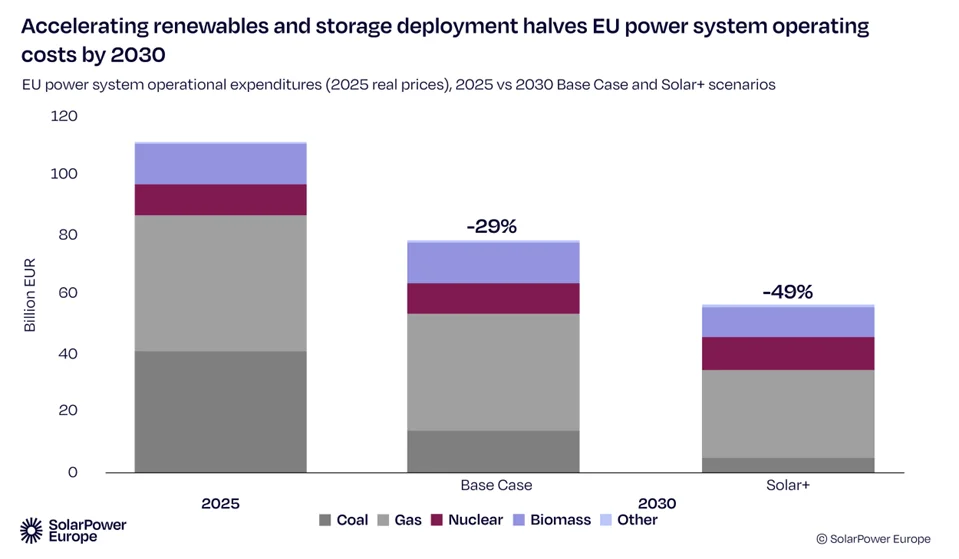
Solar power savings projections towards 2030
The outlook for 2030 shows the long-term structural impact solar energy could have on Europe’s energy security.
Between 2026 and 2030, SolarPower Europe estimates that photovoltaic generation could avoid a total of €170 billion in gas import costs across the EU. This would amount to approximately €34 billion per year, nearly equivalent to the annual investment required to install 34 GW of new solar capacity every year.