The global wind turbine market: new record installations and players
In the global wind turbine market, 2025 marks a new turning point for size and industrial structure. According to the study Global Wind Turbine Market Shares 2025 published by BloombergNEF, last year, 169 gigawatts of new wind capacity were installed globally, the highest level ever recorded and the third consecutive year of record growth.
New capacity increased by 38% compared to 2024, signaling a strong acceleration in wind energy development. Almost all new installations involved onshore projects: 161 GW, accounting for 95% of the total, while 8 GW were installed offshore.
A profound transformation is also occurring in the industrial geography of the sector. Eight of the top ten global turbine manufacturers are Chinese companies; consequently, installation growth has been primarily driven by China’s domestic market.
Surprisingly, India has become the largest wind market outside of China, surpassing the United States and Germany.
Wind turbine installations in 2025
In 2025, wind project developers commissioned 169 GW of new wind turbines globally, setting a historical record for annual installations.
Growth was particularly strong in the onshore segment. Land-based installations accounted for 161 GW of new global capacity, while offshore wind contributed 8 GW of new facilities.
According to BloombergNEF, the pace of expansion confirms wind’s central role in the global energy transition. However, the analysis of manufacturers’ market shares also reveals a transformation in the industry’s industrial balance, with an increasingly strong presence of Asian companies in turbine production.
China dominates the global wind turbine market
The main driver of sector growth in 2025 was the Chinese market.
China became the first country in the world to install over 100 GW of new wind capacity in a single year, a result that strengthened the industrial weight of domestic manufacturers.
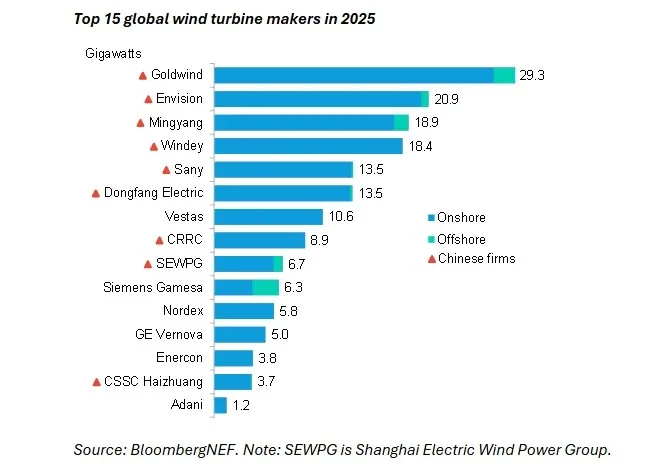
In BloombergNEF’s global ranking, the top six spots are occupied by Chinese companies.
The global leader remains Goldwind, which installed 29.3 GW of turbines in 2025, maintaining its global lead. In second place is Envision with 20.9 GW, followed by Mingyang and Windey. Sany and Dongfang Electric complete the top six, both with approximately 13.5 GW of installed turbines.
Cristian Dinca, a wind associate at BloombergNEF and the report’s lead author, points out that “thanks to stable long-term energy policy support, wind installations have increasingly concentrated in mainland China over the last decade.”
According to the analyst, Chinese companies also benefited from the race to complete projects before electricity market reforms and to meet targets set by the Chinese Five-Year Plan.
Chinese manufacturers are expanding their global presence
Despite a strong reliance on the domestic market, Chinese manufacturers are accelerating international expansion.
In 2025, 93% of the capacity installed by Chinese companies was built in China, a still very high share but lower than the 99% recorded in 2024.
This shift indicates that the export strategy is beginning to yield results. Envision and Goldwind have been the most active companies in foreign markets.
Oliver Metcalfe, head of wind research at BloombergNEF, notes that “this moment marks the emergence of Chinese manufacturers as true global players, as overseas installed capacity has increased eightfold in the past year.”
According to Metcalfe, Chinese companies are leveraging lower production costs and fast delivery times to enter new markets and compete with established suppliers in Latin America, the Middle East, Africa, and Asia.
Other countries leading the global wind turbine market
Outside of China, new wind installations have nonetheless shown significant growth.
In 2025, new installations in international markets increased by 17% year-on-year, reaching 43 GW of new capacity.
For the first time in the sector’s recent history, India has surpassed the United States and Germany, becoming the largest wind market outside of China.
According to Siddharth Shetty, BloombergNEF’s principal analyst for the Indian market, “India fully deserves its place as the world’s second-largest wind market.”
Sector growth has been driven by complex energy auctions, introduced in the country in 2018, which often require developers to integrate different renewable technologies or build facilities larger than the contracted capacity.
Danish Vestas loses ground in the global market
Among Western manufacturers, the main change concerns Vestas, a historical leader in the wind sector.
The Danish group remains the leading turbine supplier in markets outside of China. But in the global ranking, it dropped to seventh place in 2025.
It is the first time since 2013, the year BloombergNEF began publishing its manufacturer ranking, that Vestas has fallen out of the global top five.
Despite the overall ranking decline, the company maintains the broadest geographical presence among all manufacturers. Vestas, in fact, has commissioned projects in 28 different markets in 2025.
What is happening in the offshore wind market?
The offshore segment experienced a setback after three consecutive years of growth.
In 2025, 8.1 GW of new offshore wind capacity were installed, representing a contraction of approximately one-third compared to the previous year.
According to BloombergNEF, the slowdown was primarily caused by project delays in China and France. Political difficulties were also noted in the United States, where sector activity temporarily halted.
In the offshore segment, the main turbine supplier was Siemens Energy, which for the second consecutive year surpassed Chinese manufacturer Goldwind.
BloombergNEF nonetheless predicts a recovery in offshore installations in 2026, when several delayed projects and new industrial facilities in the North Sea are expected to come online.