Examining Europe’s rising fuel windfall profits
Fuel windfall profits in Europe are projected to reach almost €24 billion by 2026, according to analyses by T&E, an independent European organization for transport and environment. These figures reflect the direct impact of geopolitical tensions on pump prices.
Following the attacks by the United States and Israel on Iran on February 28, 2026, oil prices surged rapidly, primarily due to the closure of the Strait of Hormuz.
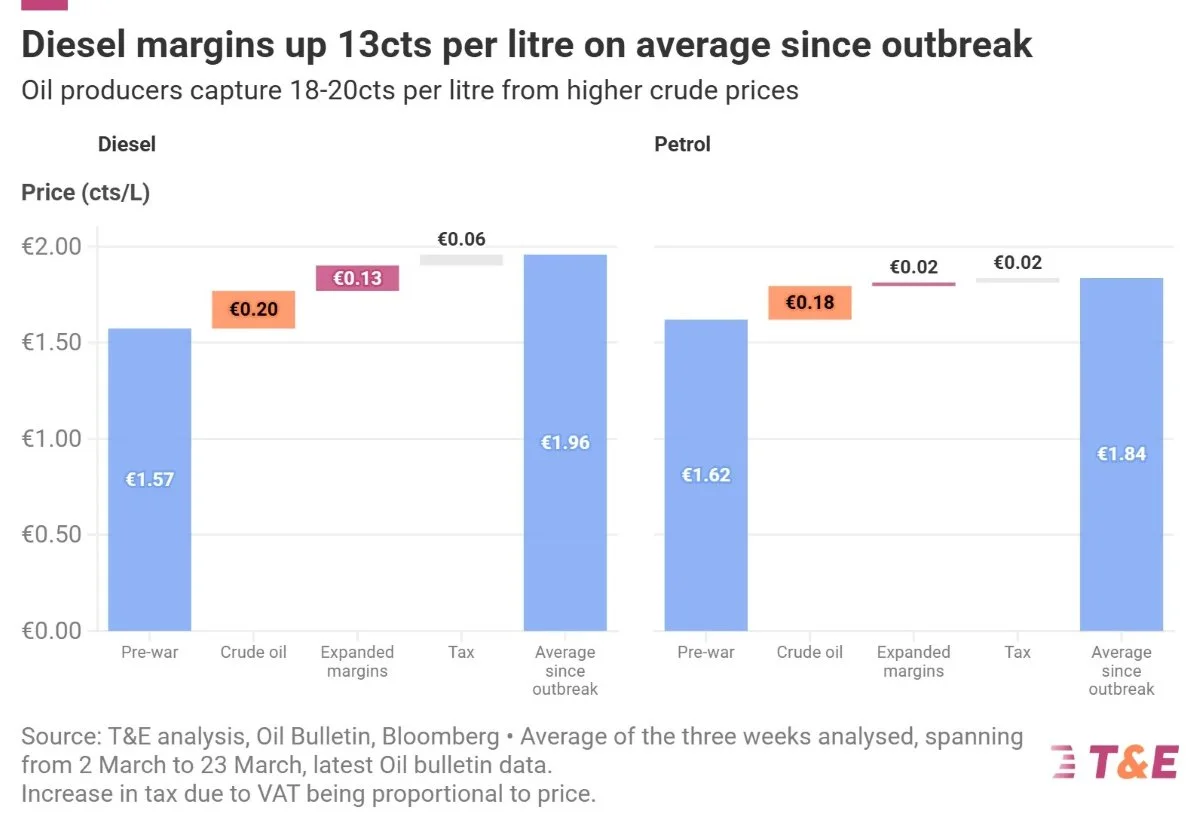
By the end of March, diesel reached €2.06 per liter and gasoline €1.89 per liter, with increases of 49 and 27 cents respectively compared to the previous period. This translates into an additional cost of approximately €27 for a 55-liter diesel tank and €15 for gasoline.
How fuel windfall profits are generated
The mechanism behind fuel windfall profits relies on the widening margin between crude oil prices and the final price at the pump. The tracker developed by T&E uses data from the Weekly Oil Bulletin of the European Commission and Brent prices to compare the current situation with the pre-crisis period (January-February 2026).
When the pump price increases faster than the cost of crude oil, the difference results in an expansion of margins along the supply chain. These additional margins, defined as “gross margin expansion,” represent extra revenue for refiners and distributors.
The method distinguishes two segments: upstream, extra revenues derived from oil prices and mainly allocated to producing countries; downstream, those related to refining and distribution, largely realized within the EU and therefore more relevant for potential fiscal policies.
Why diesel fuel margins are growing faster than gasoline
There is a strong divergence between diesel and gasoline. Diesel refining margins have increased more rapidly. This reflects a structural deficit in European refining capacity and a greater dependence on imports.
Approximately 20% of the diesel consumed in Europe is imported, while the continent maintains a vehicle fleet heavily oriented towards this fuel. This imbalance amplifies the impact of geopolitical shocks on prices and margins.
Conversely, gasoline shows more contained dynamics. High inventories in the United States and Europe, coupled with weak seasonal demand, have limited margin expansion.
How large are the 2026 fuel windfall profits?
If current conditions persist, fuel windfall profits along the European supply chain could reach €24 billion by the end of 2026 for refining and distribution.
In addition, approximately €45 billion is allocated to crude oil production, which largely falls outside European jurisdiction. To date, the analysis already estimates €1.3 billion in accumulated windfall profits since the crisis began.
This figure is part of a trend already observed in 2022, when the energy crisis linked to Russia’s invasion of Ukraine generated a “geopolitical premium” of approximately €55 billion borne by European consumers.
Are they just profits or also costs?
The analysis considers additional revenues as true windfall profits. This is because refining operating costs remain relatively stable in the short term. The energy used in refineries largely comes from internal by-products, while natural gas accounts for only about 13% of the sector’s energy consumption.
Even the increase in logistical and distribution costs does not significantly alter net margins. During the previous crisis, percentage distribution margins remained stable, while absolute profits grew.
This leads to interpreting the expansion of margins as a real transfer of value from consumers to the oil industry.
Possible policies for fuel windfall profits
The European Union already introduced a similar mechanism in 2022, with a solidarity contribution of 33% on profits exceeding 20% of the 2018-2021 average, which generated approximately €28 billion.
According to T&E, this instrument could be reactivated to intercept part of the fuel windfall profits and finance the energy transition. However, structural limits exist. A significant portion of profits, especially in diesel, is generated outside the EU, reducing the effectiveness of European taxation.
Furthermore, profits are by definition temporary. Historically, they tend to decrease as markets stabilize and margins return to their long-term average.
What is the future of the fuel market?
T&E’s analysis shows how the European system remains highly exposed to external shocks. Dependence on oil makes prices vulnerable to geopolitical crises and decisions by producing countries.
The framework highlights two key elements. On one hand, the immediate impact on consumers, with significant increases in mobility costs. On the other hand, the oil supply chain’s ability to amplify these shocks through margin expansion.
According to T&E, reducing this vulnerability requires structural interventions. The electrification of transport and the development of renewables are indicated as tools to limit exposure to future oil price increases.