New reinforced offshore wind turbine targets the world’s most challenging environments
An innovative earthquake-resistant offshore wind turbine developed by engineers at the University of Technology Sydney (UTS) could withstand earthquakes, powerful winds, and massive ocean waves, even when these extreme forces occur simultaneously.
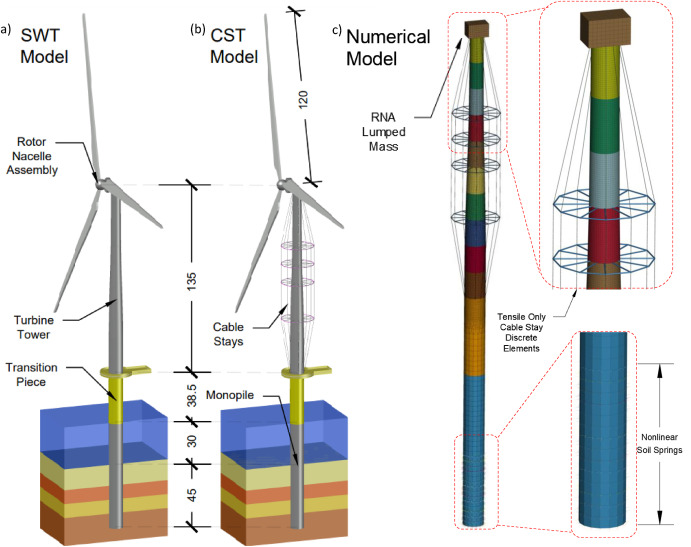
To help offshore wind farms expand into harsher environments, researchers designed a suspended cable reinforcement system that wraps around the turbine tower like an external structural frame. Inspired by cable-stayed bridges, the design strengthens the tower against combined seismic, wind, and wave loading.
“Offshore wind turbines are becoming larger and are increasingly being proposed for regions where earthquakes are a significant design concern,” said Professor Behzad Fatahi, who led the research team.
Where could the new reinforcement system be deployed?
The study focuses on the Pacific Ring of Fire, the roughly 40,000-kilometer tectonically active belt stretching around the Pacific Ocean. The region includes Australia, Asia, and the Americas, where more than 100 GW of offshore wind capacity is planned in Asian waters alone.
However, earthquake risk is not limited to the Pacific.
The Mediterranean Sea is also seismically active because of the ongoing convergence between the African and Eurasian tectonic plates. As offshore wind development accelerates across the Mediterranean, future projects could also benefit from the reinforced tower concept.
“Our research demonstrates that a relatively simple structural reinforcement concept, inspired by the cable-stayed systems used in bridges and towers, can significantly improve the dynamic performance of offshore wind turbines,” Fatahi said.
How the new design compares with existing seismic protection systems
Offshore wind turbines already use vibration-control technologies.
For example, conventional damping systems helped Japan’s Kamisu offshore wind farm survive the devastating 2011 Tōhoku earthquake and tsunami, the same disaster that triggered the Fukushima nuclear accident.
Yet these technologies have limitations.
Tuned mass dampers can reduce tower deflection, but their performance depends on the proper operation of complex mechanical systems. Tuned liquid dampers help limit oscillations, although their effectiveness varies depending on the frequency of seismic events.
The Australian team’s solution instead relies on high-strength steel stay cables, a well-established engineering approach used in suspension and cable-stayed bridges. The cables increase the tower’s bending stiffness while reducing harmful dynamic responses during extreme loading events.

Computer simulations show significant structural improvements
To evaluate the concept, researchers modeled the reinforcement system on a 15 MW offshore wind turbine, reflecting the industry’s trend toward increasingly larger machines.
According to the university, simulations showed that the cable-stayed structure substantially reduced tower acceleration, stress, and deformation. In several scenarios where the conventional turbine model experienced structural yielding or instability, the reinforced tower remained intact.
The study found that the cable system reduced internal forces in the upper sections of the tower, increased structural stiffness, minimized resonance, and prevented cross-sectional ovalization, a deformation mechanism that can contribute to structural failure.
The researchers also caution that the design remains at an early stage. Further experimental validation and engineering studies will be required before the technology can be deployed commercially.
The study, “Novel cable stay reinforced offshore wind turbine resisting combined seismic, wind and wave loading,“ was published in the journal Ocean Engineering.