


Europe’s largest industrial carbon capture and storage project has begun commercial operations, creating the continent’s first cross-border CCS chain between the Netherlands and Norway.

CCS in Europe enters a new phase with its first cross-border project
After 15 years of planned operations, seven large temporary storage tanks, a 120 km cross-border pipeline and an offshore storage site 2,600 metres below the seabed, Europe’s carbon capture and storage sector is entering new territory. The continent’s largest industrial carbon capture and storage (CCS) facility has begun commercial operations, becoming the first project of its kind to cross national borders.
The system has been designed to capture and liquefy emissions from another industrial giant, Yara Sluiskil in the Netherlands, Europe’s largest ammonia and fertiliser production complex. From there, the carbon dioxide will be transported to Norway, where it will be permanently stored in a saline aquifer off the country’s western coast.
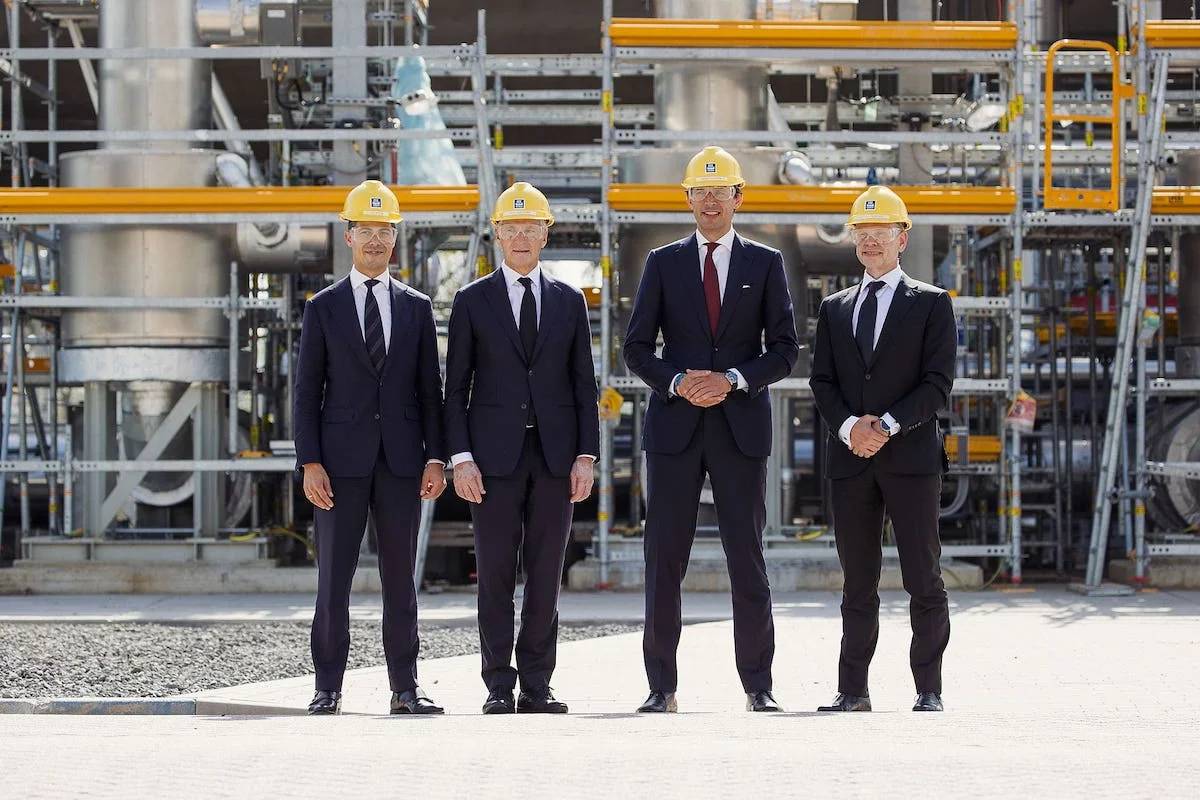
Commercial operations were officially inaugurated yesterday by Svein Tore Holsether, President and CEO of Yara International, in the presence of Norwegian Prime Minister Jonas Gahr Støre, Dutch Prime Minister Rob Jetten and European Commissioner for Climate Wopke Hoekstra.
“Europe needs concrete climate solutions that deliver real emission reductions while strengthening industrial competitiveness,” Commissioner Hoekstra said. “The Sluiskil carbon capture and storage project demonstrates what can be achieved when innovation and cross-border cooperation come together. This is exactly the kind of project Europe needs to combine climate ambition with a strong and resilient industrial base.”
But is that really the case? Can this initiative genuinely be considered evidence that CCS in Europe can decarbonise the continent’s industrial sector?
Yara Sluiskil’s large-scale CCS facility
If the assessment were based solely on the promised results, the answer would be yes.
The industrial complex produces around 1.9 million tonnes of ammonia every year, as well as approximately 5 million tonnes of fertilisers and other finished products. This output is particularly important given the effects that the new conflict in the Middle East is having on the global nitrogen fertiliser market.
At the same time, however, the facility generates around 3.2 million tonnes of CO2 every year.
A substantial share of these emissions, around 1.4 million tonnes, is already incorporated into a circular economy system, with the CO2 reused in commercial greenhouses, carbonated drinks and urea used to remove nitrogen oxides (NOx) from diesel engines.
The remaining 1.8 million tonnes of CO2 are released directly into the atmosphere. This is where the new large-scale CCS facility comes into play.
CCS in Europe: the journey from Sluiskil to the Norwegian Sea
The system is expected to capture up to 800,000 tonnes of CO2 every year, preventing these emissions from reaching the atmosphere.
Through a series of processes including compression, drying and liquefaction using a refrigerant, the carbon dioxide will be converted into liquid form and temporarily stored in seven horizontal tanks before being shipped by sea.
Twice a week, a Northern Lights vessel will arrive at Sluiskil. The liquid CO2 will be transferred from the storage tanks onto the ship and transported to Øygarden, Norway.
From there, it will be injected through a pipeline into a geological reservoir 2,600 metres below the seabed for permanent storage, under a system verified and approved by the Norwegian authorities.
The process may sound straightforward, but in practice it is highly complex, particularly from a regulatory perspective, as Norwegian Prime Minister Jonas Gahr Støre explained:
“Protocols are needed to transport CO2 from one country to another. I have signed several of them and, once that is done, you might say: ‘Fine, let’s start moving the CO2’, but it does not happen overnight. There are many elements that have to fall into place.”
“This will be the first example of CO2 being transported across borders in a safe and regulated way. The European framework is fundamental: Norway is an integral part of the internal market and shares the same climate objectives as the European Union. We have a Green Alliance with the EU, so it is all set out in writing. For the time being, transport will take place by ship to the Norwegian coast and then down into the subsea reservoirs. At the same time, I know that industry is considering the possibility of building a dedicated pipeline from the European coast to the continental shelf, to collect CO2 directly from industries in continental Europe.”
Are CCS facilities really a solution for Europe?
This cross-border project, currently unique of its kind, is the result of the EU-Norway Green Alliance signed in 2023. It provides an example of cooperation between private investment and public support, bringing together industry, EU countries and Norway.
However, whether this model can be replicated on a large scale remains uncertain, and the main obstacle is not necessarily technological.
According to Carbon Management Europe, Europe has significant carbon dioxide removal potential, estimated at 47 Mtpa, while its total storage capacity exceeds expected demand. Yet a substantial geographical imbalance remains.
CO2 storage capacity is concentrated in only a handful of countries, including Norway, the UK and the Netherlands, forcing countries with less favourable geological conditions, such as France or the Netherlands, to rely on cross-border solutions.
This creates what has been described as a “coordination risk” between companies developing carbon capture facilities and those operating storage sites, potentially preventing projects from reaching final investment decisions.
The economics of CCS vary sharply between industries
There is another major challenge. A recent study published on ScienceDirect highlights how differences in costs between industrial sectors currently result in widely varying economic assessments of CCUS deployment.
Capture costs in cement production, for example, “characterised by high shares of process emissions and limited direct abatement alternatives, differ substantially from those of refineries, steel plants or waste-to-energy facilities, where flue gas composition, plant scale and integration constraints vary considerably”.
In other words, the actual cost of capturing each tonne of carbon dioxide varies significantly depending on the industrial sector and the targeted capture rate.
Economic literature on the subject shows that abatement costs range from approximately €20/tCO2 for ammonia, where industrial gas purification benefits from already highly concentrated carbon dioxide streams, to around €100/tCO2 in the petrochemical and refining sectors, where emissions are instead fragmented and occur at lower concentrations.
Between these two extremes are several key heavy-industry sectors, including cement, at around €50/tCO2, and steel and paper, at approximately €60/tCO2.
Increasing capture rates beyond certain energy-performance thresholds can also lead to higher energy consumption. These penalties can rise non-linearly, meaning that each additional tonne of CO2 captured may become significantly more expensive than the previous one.


