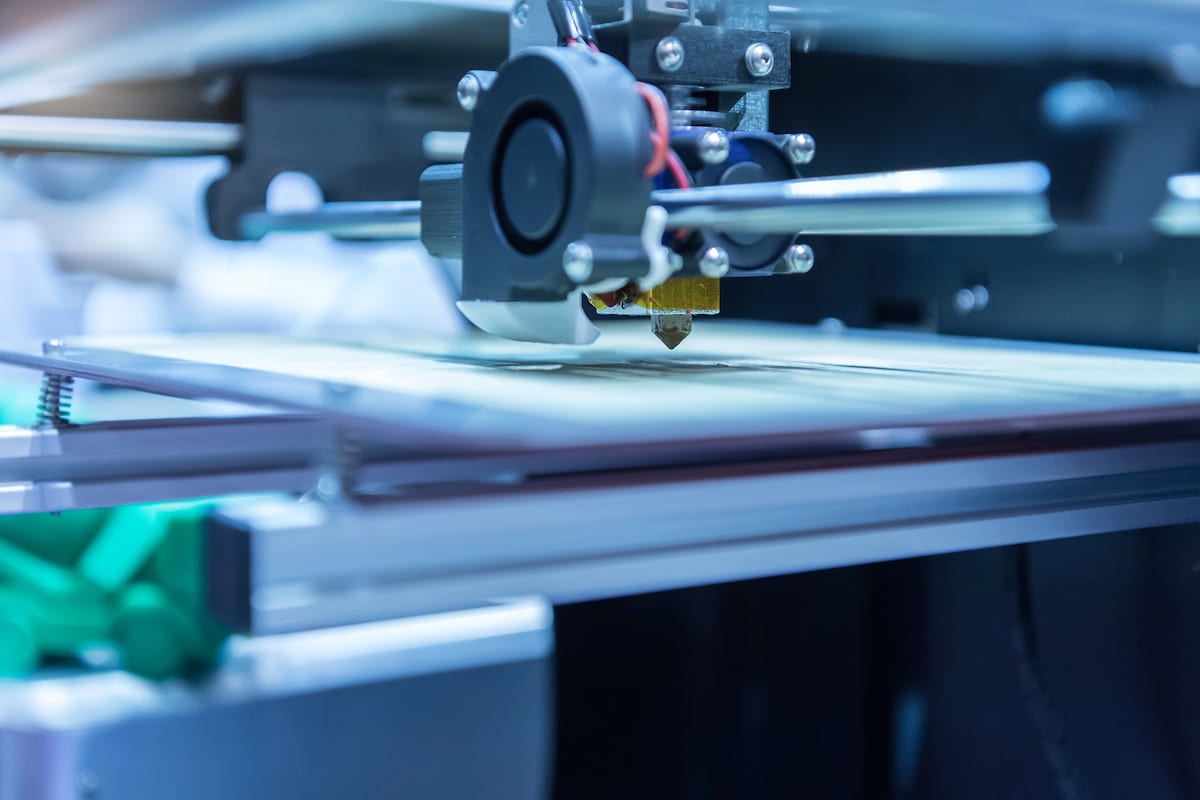
How 3D printing batteries is changing lithium battery design
The future of rechargeable systems may rely less on factory constraints and more on geometry. This is the key takeaway from a recent review analysing advances in 3D printing batteries, a manufacturing approach that enables the fabrication of electrodes, solid electrolytes, current collectors and separators through additive processes.
In theory, this technology can overcome the structural and compositional limits of conventional battery production. Instead of adapting performance to manufacturing constraints, 3D printing batteries turns electrochemical limits into active design variables. This is made possible by precise control over three-dimensional architectures, improving ion and electron transport, increasing energy density, and optimising interfaces and safety.
Also read Battery recycling with plasma reaches up to 95% recovery
Additive manufacturing techniques for 3D printing batteries
A new review paper titled “3D printing in lithium battery manufacturing: Opportunities, challenges, and perspectives”, published in Materials Science and Engineering: R: Reports, examines the main additive manufacturing techniques applied to lithium-based systems.
These include direct ink writing, laser powder bed fusion, photopolymerisation, and fused deposition modelling. Each method offers distinct advantages in shaping battery components with high precision and tailored geometries.
The advantages of 3D printing batteries
Overall, these technologies enable a shift towards a structure-centric manufacturing approach, where the spatial configuration of materials determines energy density and system stability.
In practical terms, additive manufacturing allows the production of ultra-thick electrodes, above 300 µm, capable of maximising areal capacity without compromising mechanical integrity. It also enables hierarchical architectures that enhance ion and electron transport through precise control of porosity and tortuosity at each volumetric point.
Advanced geometries, such as gyroid structures, can be used for solid electrolytes and current collectors, helping to prevent lithium dendrite formation.
Beyond design flexibility, 3D printing batteries also improves production efficiency. It reduces material waste, eliminates solvent-intensive steps, and accelerates the optimisation cycle between computational design and experimental validation.
It also opens the door to integrating batteries directly into device structures, optimising space and weight. In addition, the same approach can be applied to print casings and battery thermal management systems using materials with high thermal conductivity.
Technical and industrial challenges
Despite these advantages, several barriers remain. Additive processes are still slower than conventional methods, and there is an ongoing trade-off between printability and electrochemical performance.
For instance, achieving high ionic conductivity in solid electrolytes requires a high ceramic content, which can lead to nozzle clogging and poor ink flow. Moreover, many oxide- and sulphide-based inks are highly sensitive to moisture and air.
Scalability also remains a critical issue. Most extrusion-based techniques operate at resolutions between 100 and 200 µm, far above the nanometric scale required for optimal lithium-ion transport. Higher precision technologies exist, but they come at significantly higher costs.
Future outlook for 3D printing batteries
According to the authors, the next phase of development will see convergence between additive manufacturing, AI-driven design and closed-loop process control.
This integration will be essential not only to identify new materials and ink formulations, but also to transition from static production lines to adaptive systems capable of real-time monitoring, automatic defect detection and in-process correction through advanced robotics.
The study outlines two potential industrial pathways:
- In the short term, 3D printing batteries will likely focus on high-value, low-volume applications such as medical devices, wearables, drones and VR or AR systems, where integrating the battery into the device structure provides a competitive advantage.
- In the long term, hybrid manufacturing systems could be adopted for electric vehicles and grid-scale storage, combining additive manufacturing for critical components with conventional methods for large-scale production.