How wildfire thunderstorms are changing the behaviour of extreme fires
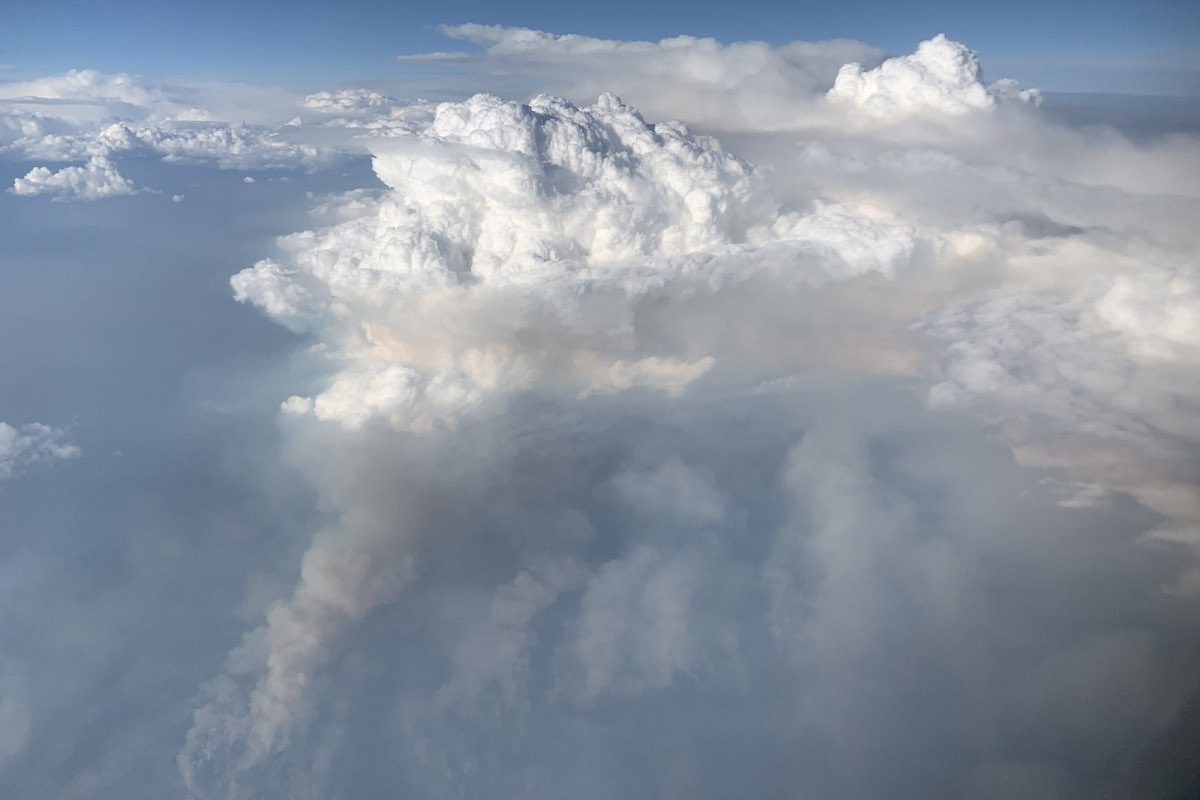
Ever heard of the fire-breathing dragon of the clouds? It is not a mythical creature or a fantasy character, but a rare atmospheric phenomenon that has returned to the spotlight as devastating wildfires sweep across Europe. For the first time, firefighters tackling the massive blaze in the Gironde region of France encountered a pyrocumulonimbus, a towering cloud created by the intense heat of a wildfire that can generate lightning, rainfall, violent winds and vast quantities of pollutants. Even more concerning, it can ignite new fires many kilometres away.
Fire crews described it as an event “never seen before in France”. Yet for NASA, which has been studying the phenomenon since 2016, this so-called “dragon” is already well known, particularly after a growing number of pyrocumulonimbus events were recorded in the United States and Canada.
Although scientists are still working to fully understand these storms, evidence increasingly links them to climate change. As global temperatures continue to rise, researchers warn that these extraordinary wildfire thunderstorms could become more frequent, including in regions where they have never previously been observed.
What is a pyrocumulonimbus and how does it form?
Officially recognised by the World Meteorological Organization (WMO), the scientific name is cumulonimbus flammagenitus. More commonly, however, it is known as a pyrocumulonimbus, or pyroCb.
It represents the most intense type of flammagenitus cloud, a family of cumuliform clouds generated by an exceptionally strong heat source. Wildfires are the most common trigger today, but they are not the only one. One of the earliest documented cases occurred over Hiroshima in 1945, following the atomic explosion. More recently, a similar process was observed after the Hunga Tonga-Hunga Ha’apai volcanic eruption.
Whether triggered by a wildfire, a volcanic eruption or another extreme heat source, the formation process follows the same physical principles.
The enormous thermal energy released heats large masses of air, causing them to rise rapidly in a powerful convective plume. This column carries smoke, ash, airborne particles and water vapour released by burning vegetation. If the atmosphere above the fire is sufficiently unstable and contains enough moisture, the plume continues climbing into the upper troposphere, and sometimes even the lower stratosphere. There, colder temperatures condense the water vapour, producing the towering cloud structure typical of severe thunderstorms.
These clouds can generate rain, hail, lightning, destructive wind gusts and even tornadoes. More importantly, once formed they can become self-sustaining through the latent heat released during condensation, no longer relying on the original fire as their sole energy source. The consequences can extend well beyond the wildfire itself, affecting regional and even global atmospheric processes.
One of the most remarkable examples occurred in 2017 over the north-western Pacific, where a massive pyroCb injected smoke into the stratosphere. The resulting plume spread around the Northern Polar region within weeks and remained detectable for more than eight months.
Wildfire thunderstorms and climate change
Recent Australian research analysing almost 30 years of observations found that wildfire thunderstorms are most likely to develop on days with very hot, dry and unstable lower atmospheric layers, combined with moderate winds and increasing moisture in the middle atmosphere during the afternoon.
This additional moisture provides the fuel that transforms an ordinary smoke plume into a fully developed thunderstorm cloud. It also highlights why climate change plays such an important role, even if the relationship remains complex and cannot yet be quantified with complete certainty.
Researchers Wenyuan Ma, Jason Sharples and Zlatko Jovanoski, from the University of New South Wales, produced one of the first assessments of how future climate conditions could influence the probability of pyroCb formation. Their findings indicate that increasing atmospheric instability together with declining vegetation moisture will significantly raise the risk.
The recent French event, currently considered the first documented pyrocumulonimbus in Europe, also suggests that these storms are expanding into new geographical regions.
Australia provides perhaps the clearest evidence of this trend. According to the national pyroCb database, 144 events have been documented since the satellite era began, with 135 occurring after 2003. Since then, almost every year has recorded at least one event, culminating in the catastrophic 2019 Black Summer wildfire season.
Climate projections suggest the increase in risk will be strongest in the coming decades, particularly under the IPCC SSP3-7.0 high-emissions scenario, which could see average global temperatures rise by around 4°C by the end of the century.
According to the researchers, “under the low-emissions scenario, the probability driven by the mean vegetation water content declines over the long term compared with the near future, whereas probabilities driven by median and extreme vegetation moisture values continue to increase, although at a much slower rate.”
The authors also stress that reducing global CO₂ emissions remains essential to slow the increasing occurrence of these extreme atmospheric events.
A major source of pollution reaching the stratosphere
Beyond their unpredictability, wildfire thunderstorms pose a significant environmental threat.
Pyrocumulonimbus clouds inject smoke directly into the stratosphere, and aircraft observations collected over 13 years indicate they account for 10% to 25% of the black carbon and organic aerosols found in its lower layers. These particles are remarkably persistent, often remaining in the atmosphere for more than one year with very limited chemical or photochemical degradation.
Even relatively small wildfires can produce disproportionately large atmospheric impacts. The 2017 north-western Pacific pyroCb, for example, was still responsible for roughly 40% of the black carbon aerosol present in the Northern Hemisphere’s lower stratosphere one year later.
This matters because these pollutants alter the Earth’s radiative balance, atmospheric chemistry and global wind circulation. Their effects can amplify the climate crisis, creating feedback mechanisms that make future wildfire thunderstorms even more likely.