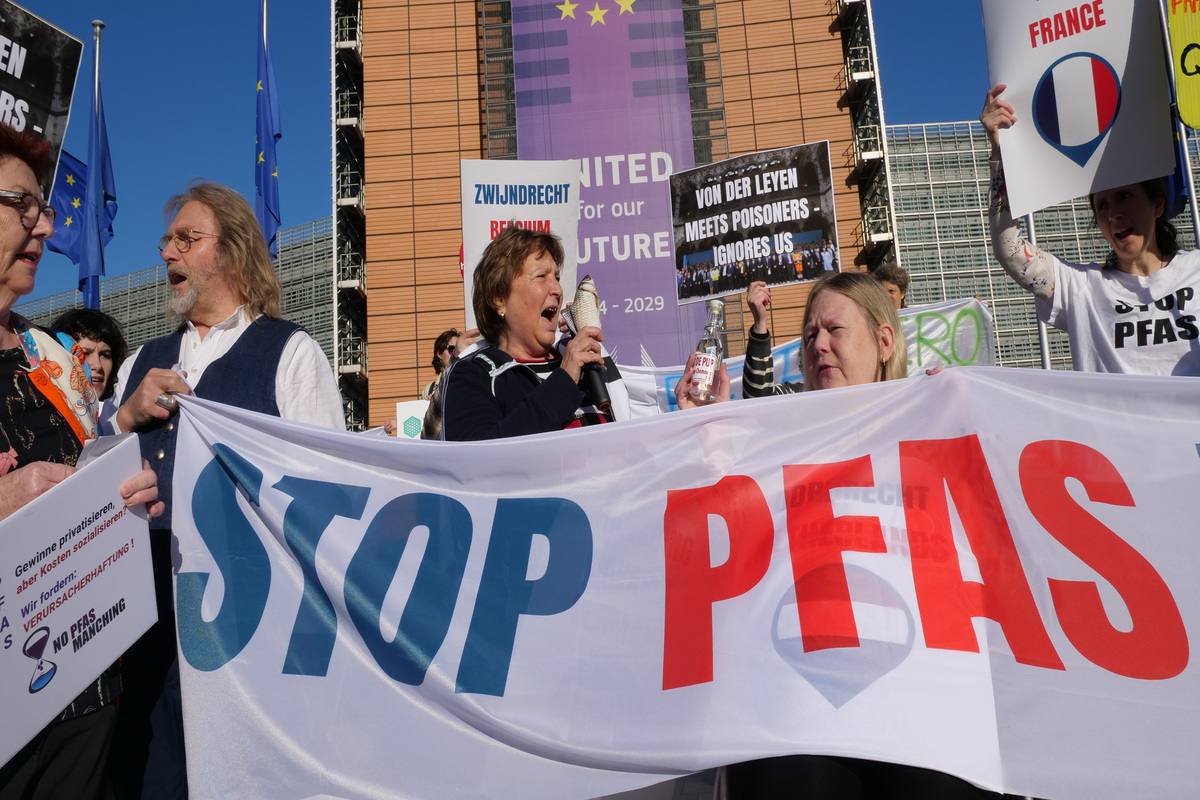
Anti-PFAS movements go unheard by the EU Commission
For the third time since 2023, anti-PFAS movements have been unable to meet with Ursula von der Leyen due to “scheduling conflicts,” as explained by the EU Commission President’s cabinet.
Representatives from the communities most affected by this form of pollution, at least 26 people from various PFAS hotspots across France, Germany, Italy, Belgium, Denmark, and the Netherlands, traveled to Brussels to share personal experiences and testimonies with von der Leyen. These chemicals, also known as “forever chemicals,” are having a severe impact on their lives. Unable to meet her, they protested in front of the Commission headquarters, demanding an end to PFAS pollution. One of their banners read: “von der Leyen meets the polluters, but ignores us.”
European environmental organizations decry the Commission’s closed-off attitude toward citizens and victims, who are calling for courageous action on PFAS pollution to protect public health and the environment. These same organizations accuse Brussels of instead throwing open its doors to the chemical industry.
Almost 70% of the Commission cabinet’s meetings last year reportedly involved industry representatives. Research by the Corporate Europe Observatory highlighted privileged access granted to businesses. In 2025, industry had 93 high-level meetings with EU Commissioners and their cabinet offices; NGOs had only 19. Furthermore, the second von der Leyen Commission has not yet published a proposal for a reform of the REACH regulation, the chemical substances law.
On February 11, NGOs reported, the Commission President again ignored victims of chemical pollution and, in the same days, instead met with EU industry leaders in Antwerp, at an event coordinated by the chemical sector.
Demands of anti-PFAS movements
In October 2023, victims of PFAS pollution from Belgium, Italy, and France had requested an audience with Ursula von der Leyen for a discussion on the devastating health consequences of per- and polyfluoroalkyl substances. Since then, these voices have remained unheard.
“It is deeply concerning that time has been granted to interact with representatives of the chemical industry, whose activities have had a severe and lasting impact on our lives, while our repeated requests for dialogue have remained unanswered,” stated the PFAS frontline communities in a letter addressed to von der Leyen.
“In France, over 60,000 people can no longer drink tap water. In Belgium, residents of Ronse, just 34 miles from Brussels, have discovered severe environmental and human body contamination. In Germany, a recent study found that 69% of fish are contaminated with PFAS,” citizens recalled in the letter.
Across Europe, exposure occurs through drinking water and food, largely due to emissions from industrial production and waste disposal sites. “Focusing solely on consumer use ignores the main sources of contamination and fails to effectively address the PFAS pollution crisis,” emphasized PFAS-contaminated communities.
The costs of PFAS pollution
Scandals related to chemical pollution continue to emerge across Europe. Victims are denouncing companies like 3M, Dupont, Chemours, or Bayer-Monsanto, which not only hide the harmful effects of chemicals but are authorized to continue using them.
The social, environmental, and economic costs of PFAS pollution are staggering. According to a study by the European Commission, if no targeted regulatory action is taken on PFAS pollution levels by 2050, the total cost of this poisoning will reach 440 billion euros. Addressing the problem of PFAS emissions at the source could save 110 billion euros by 2040. In contrast, treating contaminated water alone could cost up to 1,700 billion euros.
More than 343,000 people have so far supported the petition, calling on European leaders to defend laws that protect people and nature, rather than bowing to the interests of polluters.