Strengthening EU resilience in the face of accelerating climate change
The European Union is not prepared for the escalating impacts of climate change and should urgently increase investment to shield citizens and infrastructure from extreme events such as floods, wildfires and heatwaves. Due to climate change, Europe has become the fastest-warming continent in the world. Europeans are already experiencing the consequences of insufficient preparedness. Adapting to a hotter future is a manageable, though highly demanding, challenge.
The new report, Strengthening resilience to climate change, prepared by the European Scientific Advisory Board on Climate Change (ESABCC), sets out recommendations for an effective and coherent adaptation framework in response to growing and systemic climate risks.
Current efforts remain insufficient
Without adequate adaptation, climate impacts will undermine Europe’s competitiveness, strain public budgets and increase security risks. Many risks are transboundary and threaten supply chains and financial systems. For these reasons, the ESABCC calls on the EU to reinforce its framework for coherent and effective adaptation.
Ottmar Edenhofer, Chair of the ESABCC, stated: “Extreme weather and climate-related events are already causing severe losses across Europe. Extreme heat alone has led to tens of thousands of premature deaths, including around 24,000 in the summer of 2025. Economic damage to infrastructure and physical assets now averages nearly €45 billion per year.”
Europe warming twice as fast as the global average
Global average temperatures have increased by nearly 1.4°C compared to pre-industrial levels. Due to insufficient global mitigation progress, exceeding the 1.5°C target of the Paris Agreement is becoming increasingly likely. Europe is warming at roughly twice the global average rate.
Over the past five years, the continent has recorded annual average temperatures approximately 2.4°C above pre-industrial levels. Extreme weather and climate-related events have caused significant loss of life and severe damage to ecosystems and economies:
- Extreme heat: it has already caused tens of thousands of premature deaths in Europe, nearly 24,000 in the summer of 2025 alone. Of these, more than two thirds were attributed to climate change.
- Flooding: torrential rainfall has caused casualties and severe damage to cities and infrastructure.
- Economic damage: estimated losses to infrastructure and material assets reached an average of nearly €45 billion per year in the period 2020–2024, five times higher than in 1980–1989.
Preparing for up to 3°C of warming by 2100
The Committee recommends that the EU prepare collectively for warming between 2.8°C and 3.3°C by 2100. Even if current national commitments are fully implemented, they would not prevent warming of 2.3–2.5°C this century, according to the United Nations.
Member states should use these benchmarks to design policies that support citizens and businesses in adapting to worsening climate conditions. This includes avoiding construction in flood-prone areas, supporting farmers affected by drought and redesigning urban spaces to protect people from extreme heat.
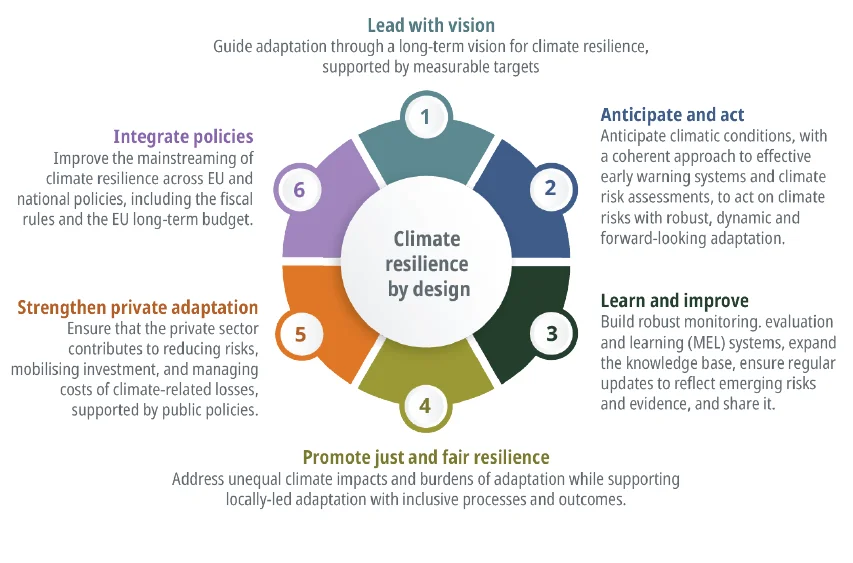
Five key recommendations to address climate change in Europe
To prepare for higher warming levels, the ESABCC proposes five key recommendations:
- Make climate risk assessments mandatory and harmonised across all EU policies.
- Adopt a common planning reference aligned with warming of 2.8–3.3°C by 2100.
- Define a clear vision for a climate-resilient EU by 2050, supported by measurable targets.
- Integrate climate resilience into all EU policies, programmes and investments.
- Mobilise public and private investment and establish a coherent approach to managing rising climate impact costs through the EU budget.
Adaptation cannot replace mitigation
Adaptation has limits. Each additional fraction of global warming increases risks, and adaptation cannot substitute for mitigation. Deep emission reductions remain essential to stabilise temperatures.
Jette Bredahl Jacobsen, Vice-Chair of the Committee, concluded: “Adaptation cannot prevent all losses; mitigation efforts remain essential to keep climate hazards at manageable levels.”