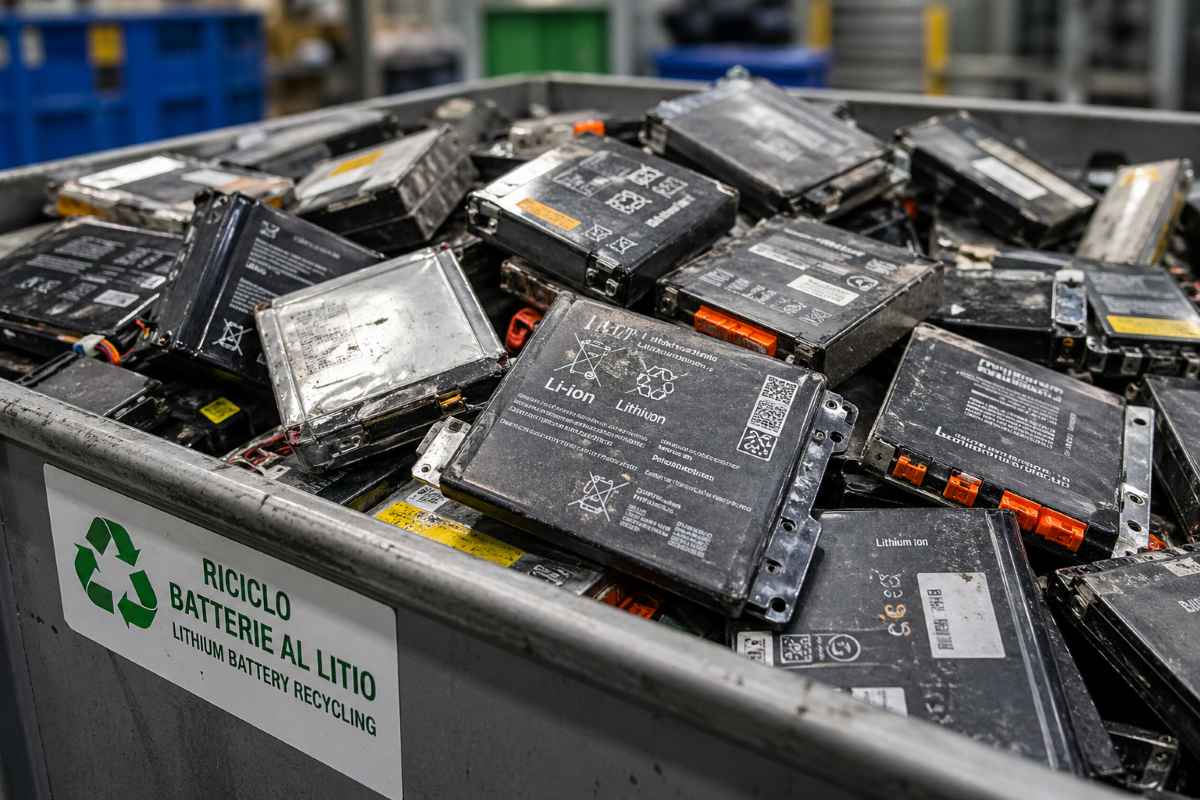
A significant advance in lithium battery recycling could reshape how critical materials are recovered from end-of-life cells. A study published in Small by researchers at Rice University shows it is possible to extract key raw materials rapidly, achieving efficiency levels of about 65% in just one minute at room temperature.
The research outlines a hydrometallurgical system based on aqueous solutions that overcomes several limitations of current technologies.
The team developed an approach designed to improve recovery efficiency for lithium, nickel, cobalt, and manganese, materials facing growing global demand.
This comes amid surging demand for lithium-ion batteries, driven by transport electrification and the expansion of consumer electronics, while end-of-life material recovery remains limited.
Aqueous solutions reshape lithium battery recycling
At the core of the innovation is the use of aqueous ammonium chloride salt solutions as leaching agents. This method falls within hydrometallurgy, where metals are dissolved into solution and later recovered through chemical processes.
Compared with conventional methods, often reliant on aggressive acids or more complex solvents such as deep eutectic solvents, the new system operates under simpler conditions.
Water reduces the viscosity of the medium, enabling greater molecular mobility and faster reaction kinetics. The result is shorter processing times and higher overall efficiency.
Tests show that most metal extraction occurs within the first few minutes, marking a clear improvement over conventional systems, where processing can take significantly longer.
Lower energy costs with room-temperature extraction
Experimental results indicate that the system operates effectively under mild conditions without compromising performance. Around 65% of metals are extracted in just one minute, while slightly longer reaction times push efficiency above 75% for several elements.
This is achieved without high temperatures or extended processing cycles, two factors that significantly affect the energy and environmental costs of existing technologies.
Among the compounds tested, hydroxylammonium chloride delivered the best performance. The speed of the process and its ability to operate at room temperature are key advantages for potential industrial-scale applications, where energy efficiency is critical.
Redox chemistry drives efficiency gains
One of the most important findings of the study lies in the chemical mechanism behind the process. Rather than simple acid dissolution, the system relies on more complex chemistry.
Hydroxylammonium chloride contains an active nitrogen-based redox center that directly participates in the reaction. This facilitates the reduction of metal oxides in cathode materials and promotes the formation of soluble species, accelerating electron transfer.
Researchers note that factors traditionally considered central, such as pH or chloride concentration, are less influential than the presence of reactive chemical groups and the system’s ability to enhance mass transport. This combination is what makes the process faster and more effective.
Implications for sustainability and supply chains
The impact of the new method extends beyond technology into the broader sustainability of the energy sector. Improving recovery efficiency for critical materials could reduce dependence on primary mining resources and ease pressure on global supply chains.
At the same time, the use of less toxic aqueous solutions compared with traditional solvents lowers environmental risks and simplifies waste management.
Another key advantage is the potential to reuse recovered metals in new battery production, supporting circular economy models. This is particularly relevant as access to strategic raw materials becomes increasingly critical for energy technologies.
Industrial outlook for lithium battery recycling
The system’s characteristics suggest strong scalability potential, supporting future industrial adoption. Its relatively simple operating conditions, combined with rapid processing, offer clear advantages over existing technologies.
The research also points toward a broader direction for next-generation recycling systems, integrating low-toxicity solvents with targeted chemical functionality.
In this context, lithium battery recycling remains a strategic pillar of the energy transition, not only for waste management but also for securing critical material supply.
Efficient recovery of lithium, nickel, cobalt, and manganese will be essential to sustain the growth of electric technologies and reduce the environmental impact across the battery lifecycle.