Rinnovabili • Rinnovabili •

Lignin-based carbon fibre could make cars lighter and more sustainable

Researchers at Washington University in St. Louis have developed a new carbon fibre using lignin from paper industry waste, potentially reducing production costs by 25% while meeting automotive performance standards.

Lignin-based carbon fibre offers a sustainable alternative to petroleum-derived materials Waste from the paper industry could help transform carbon fibre production, offering a more sustainable alternative to conventional petroleum-based materials. Carbon fibre is widely used in the automotive and aerospace industries because of its exceptional strength and low weight. However, its reliance on fossil-derived raw materials makes production expensive and environmentally demanding. Lignin, a natural substance obtained from wood, could provide an alternative to petroleum-based components. Until now, however, lignin-derived fibres have struggled to achieve the mechanical performance required for industrial applications. Researchers at Washington University in St. Louis, in the United States, have investigated a new production process that could overcome these limitations. Their findings, published in the scientific journal Matter, demonstrate how paper industry waste could be used to manufacture high-performance carbon fibre. How researchers improved lignin-based carbon fibre The key to the research lies in lignin, the second most abundant natural biopolymer on Earth. It is generated as a by-product of the pulp and paper industry and biorefining processes, where its disposal and management can have significant environmental implications. The researchers focused on a fundamental property of carbon fibre: its internal crystalline structure. Carbon fibres contain extremely small crystals whose orientation directly influences the material's properties. The more closely these crystals align in the same direction, the greater the fibre's mechanical strength and electrical conductivity. Improving this alignment became the central objective of the research. Replacing petroleum-derived materials with lignin Conventional carbon fibre production relies heavily on polyacrylonitrile (PAN), a synthetic polymer derived from petroleum. PAN is expensive and can account for up to 50% of total carbon fibre production costs, restricting the material's use largely to high-end applications. By incorporating lignin into the manufacturing process, the researchers found that they could reduce PAN consumption by 50%, potentially lowering production costs by 25% while also reducing carbon emissions. The findings suggest that lignin could make high-performance carbon fibre more economically accessible without compromising the properties required by the automotive industry. Carbon nanotubes improve strength and conductivity To achieve the necessary performance, the research team introduced carbon nanotubes, extremely small tubular carbon structures that help guide the formation and alignment of crystals within the fibre. This approach produced a stronger material with improved electrical conductivity. The resulting fibre achieved a tensile strength of 2.04 GPa, indicating the maximum stress it can withstand before breaking, and a stiffness of 176 GPa, reflecting its resistance to deformation under mechanical stress. Both values exceeded the performance standards required for automotive applications, suggesting a viable route towards more sustainable lightweight materials.
Depositphotos

Lignin-based carbon fibre offers a sustainable alternative to petroleum-derived materials

Waste from the paper industry could help transform carbon fibre production, offering a more sustainable alternative to conventional petroleum-based materials. Carbon fibre is widely used in the automotive and aerospace industries because of its exceptional strength and low weight. However, its reliance on fossil-derived raw materials makes production expensive and environmentally demanding.

Lignin, a natural substance obtained from wood, could provide an alternative to petroleum-based components. Until now, however, lignin-derived fibres have struggled to achieve the mechanical performance required for industrial applications.

Researchers at Washington University in St. Louis, in the United States, have investigated a new production process that could overcome these limitations. Their findings, published in the scientific journal Matter, demonstrate how paper industry waste could be used to manufacture high-performance carbon fibre.

How researchers improved lignin-based carbon fibre

The key to the research lies in lignin, the second most abundant natural biopolymer on Earth. It is generated as a by-product of the pulp and paper industry and biorefining processes, where its disposal and management can have significant environmental implications.
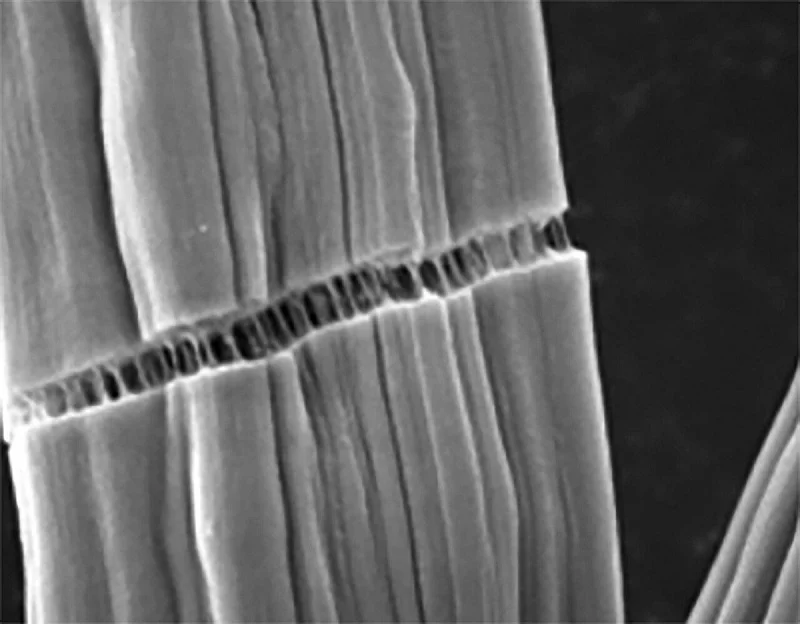
Lignin-based carbon fibre offers a sustainable alternative to petroleum-derived materials
Waste from the paper industry could help transform carbon fibre production, offering a more sustainable alternative to conventional petroleum-based materials. Carbon fibre is widely used in the automotive and aerospace industries because of its exceptional strength and low weight. However, its reliance on fossil-derived raw materials makes production expensive and environmentally demanding.  Lignin, a natural substance obtained from wood, could provide an alternative to petroleum-based components. Until now, however, lignin-derived fibres have struggled to achieve the mechanical performance required for industrial applications.  Researchers at Washington University in St. Louis, in the United States, have investigated a new production process that could overcome these limitations. Their findings, published in the scientific journal Matter, demonstrate how paper industry waste could be used to manufacture high-performance carbon fibre.
How researchers improved lignin-based carbon fibre
The key to the research lies in lignin, the second most abundant natural biopolymer on Earth. It is generated as a by-product of the pulp and paper industry and biorefining processes, where its disposal and management can have significant environmental implications.  The researchers focused on a fundamental property of carbon fibre: its internal crystalline structure.  Carbon fibres contain extremely small crystals whose orientation directly influences the material's properties. The more closely these crystals align in the same direction, the greater the fibre's mechanical strength and electrical conductivity.  Improving this alignment became the central objective of the research.
Replacing petroleum-derived materials with lignin
Conventional carbon fibre production relies heavily on polyacrylonitrile (PAN), a synthetic polymer derived from petroleum.  PAN is expensive and can account for up to 50% of total carbon fibre production costs, restricting the material's use largely to high-end applications.  By incorporating lignin into the manufacturing process, the researchers found that they could reduce PAN consumption by 50%, potentially lowering production costs by 25% while also reducing carbon emissions.  The findings suggest that lignin could make high-performance carbon fibre more economically accessible without compromising the properties required by the automotive industry.
Carbon nanotubes improve strength and conductivity
To achieve the necessary performance, the research team introduced carbon nanotubes, extremely small tubular carbon structures that help guide the formation and alignment of crystals within the fibre.  This approach produced a stronger material with improved electrical conductivity.  The resulting fibre achieved a tensile strength of 2.04 GPa, indicating the maximum stress it can withstand before breaking, and a stiffness of 176 GPa, reflecting its resistance to deformation under mechanical stress.  Both values exceeded the performance standards required for automotive applications, suggesting a viable route towards more sustainable lightweight materials.  "For the first time, this allows us to create renewable carbon fibre that meets the high-quality standards used in automotive manufacturing," said Joshua Yuan, an author of the study.  The quotation is translated from the Italian source text and has not been independently verified against the original English statement.
Could paper waste replace conventional carbon fibre?
The innovation could address one of the main obstacles that has limited the development of environmentally sustainable carbon fibre for years.  The manufacturing process involves three interconnected stages.  First, carbon nanotubes are mixed with lignin and PAN, encouraging the formation of an ordered and aligned crystalline structure from the outset.  The mixture then undergoes wet spinning to produce fibres, which are stretched during heat treatment to preserve and further improve the alignment.  Finally, a carefully controlled high-temperature treatment strengthens the material and stabilises its internal structure.  The effectiveness of the process depends on the interaction between all three stages, rather than on any individual step.  Although the results remain at the research stage, they indicate significant potential for the automotive sector.  Using lignin-based carbon fibre in vehicle manufacturing could help produce lighter cars, reducing fuel consumption in conventional vehicles and increasing driving range in electric models.  As lignin is an abundant by-product of the paper and wood industries, its use could also reduce manufacturing costs and associated emissions.  These potential advantages are supported by the study's techno-economic and life-cycle assessments, which suggest that lignin-derived carbon fibre could offer a more sustainable alternative to conventional materials if successfully developed for industrial-scale production.

The researchers focused on a fundamental property of carbon fibre: its internal crystalline structure.

Carbon fibres contain extremely small crystals whose orientation directly influences the material’s properties. The more closely these crystals align in the same direction, the greater the fibre’s mechanical strength and electrical conductivity.

Improving this alignment became the central objective of the research.

Replacing petroleum-derived materials with lignin

Conventional carbon fibre production relies heavily on polyacrylonitrile (PAN), a synthetic polymer derived from petroleum.

PAN is expensive and can account for up to 50% of total carbon fibre production costs, restricting the material’s use largely to high-end applications.

By incorporating lignin into the manufacturing process, the researchers found that they could reduce PAN consumption by 50%, potentially lowering production costs by 25% while also reducing carbon emissions.

The findings suggest that lignin could make high-performance carbon fibre more economically accessible without compromising the properties required by the automotive industry.

Carbon nanotubes improve strength and conductivity

To achieve the necessary performance, the research team introduced carbon nanotubes, extremely small tubular carbon structures that help guide the formation and alignment of crystals within the fibre.

This approach produced a stronger material with improved electrical conductivity.

The resulting fibre achieved a tensile strength of 2.04 GPa, indicating the maximum stress it can withstand before breaking, and a stiffness of 176 GPa, reflecting its resistance to deformation under mechanical stress.

Both values exceeded the performance standards required for automotive applications, suggesting a viable route towards more sustainable lightweight materials.

“For the first time, this allows us to create renewable carbon fibre that meets the high-quality standards used in automotive manufacturing,” said Joshua Yuan, an author of the study.

The quotation is translated from the Italian source text and has not been independently verified against the original English statement.

Could paper waste replace conventional carbon fibre?

The innovation could address one of the main obstacles that has limited the development of environmentally sustainable carbon fibre for years.

The manufacturing process involves three interconnected stages.

First, carbon nanotubes are mixed with lignin and PAN, encouraging the formation of an ordered and aligned crystalline structure from the outset.

The mixture then undergoes wet spinning to produce fibres, which are stretched during heat treatment to preserve and further improve the alignment.

Finally, a carefully controlled high-temperature treatment strengthens the material and stabilises its internal structure.

The effectiveness of the process depends on the interaction between all three stages, rather than on any individual step.

Although the results remain at the research stage, they indicate significant potential for the automotive sector.

Using lignin-based carbon fibre in vehicle manufacturing could help produce lighter cars, reducing fuel consumption in conventional vehicles and increasing driving range in electric models.

As lignin is an abundant by-product of the paper and wood industries, its use could also reduce manufacturing costs and associated emissions.

These potential advantages are supported by the study’s techno-economic and life-cycle assessments, which suggest that lignin-derived carbon fibre could offer a more sustainable alternative to conventional materials if successfully developed for industrial-scale production.

Rinnovabili •

About Author / Paolo Travisi

Paolo Travisi began his journalism career in 2004 as an editor for the 7Gold television network, an extraordinary training ground where he became a professional journalist, producing TV reports on topics ranging from news to culture, and contributing to programs and talk shows hosted by figures such as Aldo Biscardi, Alessandro Milan, and David Parenzo. Alongside his television work, he started writing for the online edition of Il Messaggero, then led by Davide Desario (now Director of AdnKronos), and later contributed science, technology, and culture articles to the newspaper’s print edition. His passion for writing and science led him to collaborate with the historic TuttoScienze column in La Stampa, where he interviewed prominent Italian and international scientists. From science to sustainability, he also contributed to Green&Blue by la Repubblica. At Rinnovabili, he writes daily with great enthusiasm about electric mobility, conducts car test drives, and creates videos for the outlet’s social media channels.