


A new analysis by SolarPower Europe shows that accelerating solar power and battery storage could help the EU stay on track for its 2030 climate goals, while also lowering electricity prices and reducing dependence on fossil fuel imports.

Solar and battery storage could reshape the EU energy system by 2030
As Europe grapples with fuel reserves and the additional €27 billion spent on fossil fuel imports during just 60 days of conflict, new modelling highlights a possible path to align energy security, affordability and climate targets. According to SolarPower Europe, a faster deployment of renewables could allow the EU-27 to meet its decarbonisation commitments for 2030 while simultaneously reducing energy bills.
Using electricity system modelling, the association compared two possible pathways for the European energy transition: a business-as-usual scenario and a more ambitious “Solar+” scenario based on the maximum acceleration of renewables deployment.
What immediately emerges is that in both cases, solar energy, electrification and storage systems play a central role. However, the benefits become significantly greater in the Solar+ scenario, both in terms of lower system costs and reduced electricity bills. More importantly, it is the only pathway that keeps the EU within reach of its 2030 targets.
At present, the bloc remains significantly misaligned with its renewable energy objectives. Under a business-as-usual trajectory, the EU would miss its solar capacity target by 4% and its wind capacity target by between 15% and 17%.
The Solar+ scenario and the role of battery storage
The outlook changes considerably when the pace of the energy transition accelerates. According to the modelling, a stronger political and industrial commitment could allow Europe to reach 732 GW of solar capacity and 372 GW of wind capacity within just four years. While wind would still remain below the EU benchmark, renewable energy overall would cover 68% of total electricity demand, almost perfectly aligned with the European Commission’s 69% target.
Solar power alone would supply more than 26% of Europe’s electricity consumption.
At the same time, battery storage capacity would increase eightfold compared with 2025 levels, reaching 171 GW of power and around 600 GWh of stored energy. The average storage duration would also rise from 1.9 hours in 2025 to 3.5 hours by 2030, helping to manage solar generation peaks and reduce market volatility.
Battery storage remains below Europe’s real needs
Despite the progress outlined in the Solar+ scenario, Sonja Risteska of SolarPower Europe warned that Europe would still fall short of the storage volumes required for a fully resilient electricity system.
“Even in this more ambitious scenario, Europe does not achieve the storage volumes it truly needs, which underlines the urgency of stronger political action to unlock flexibility at scale. Only by closing this gap will renewables be able to fully guarantee energy security, stability and affordable electricity for consumers.”
Lower electricity prices and reduced fossil fuel costs
The most immediate consequence of the Solar+ pathway would be a sharp reduction in operating costs across the electricity system.
By reducing the role of fossil fuels, electricity system operating costs could be cut by 50%, generating annual savings of €55 billion compared with 2025 levels. Between 2026 and 2030 alone, the scenario would avoid a cumulative €223 billion in gas import costs linked to electricity generation.
The impact would also extend directly to consumer bills. Variable renewables would set the marginal electricity price during 19% of the hours in a year, compared with 14% in the baseline scenario, significantly reducing the influence of gas on wholesale power prices.
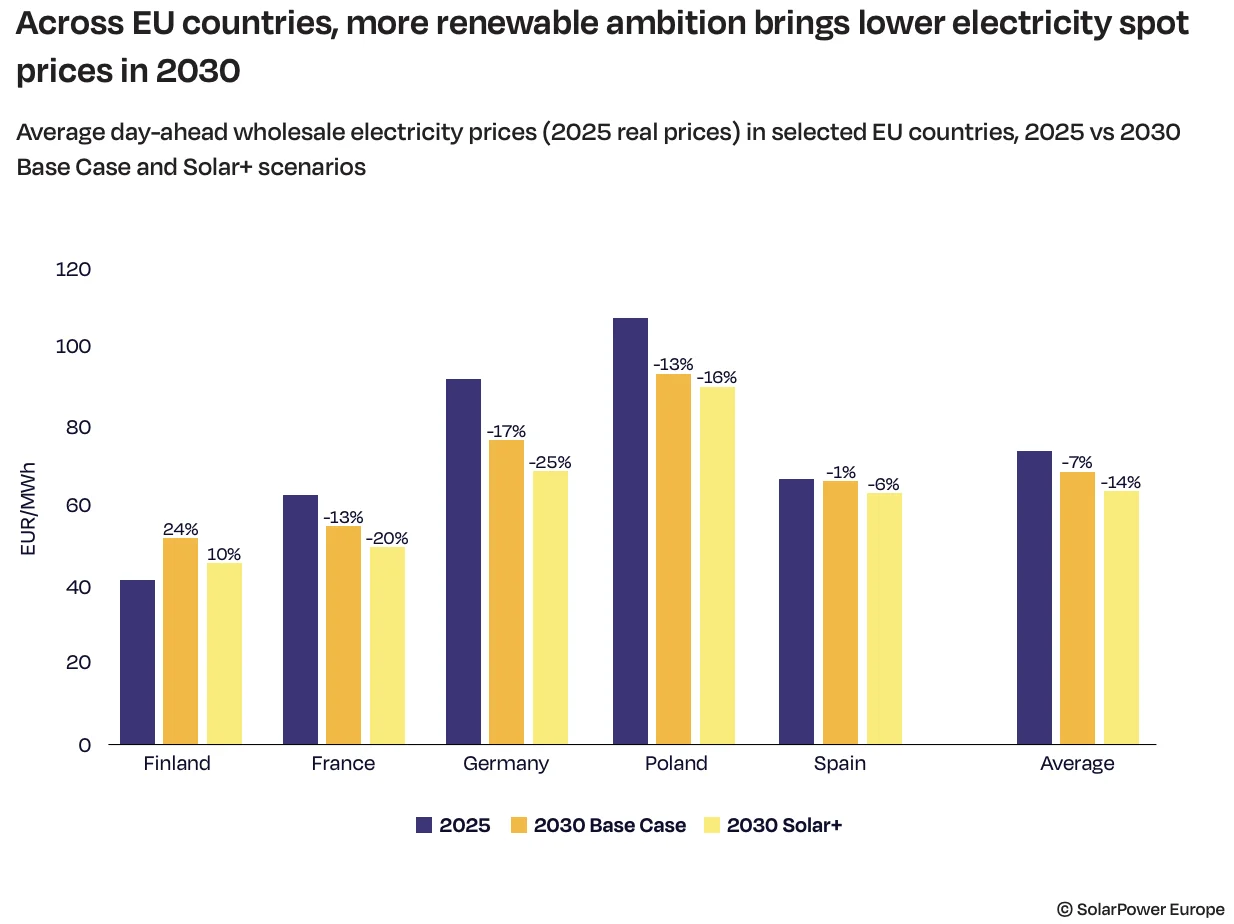
On average, the Solar+ scenario would lower day-ahead wholesale electricity prices by 14% by 2030 compared with 2025 levels. In higher-cost markets such as Germany, the reduction could reach 25%.
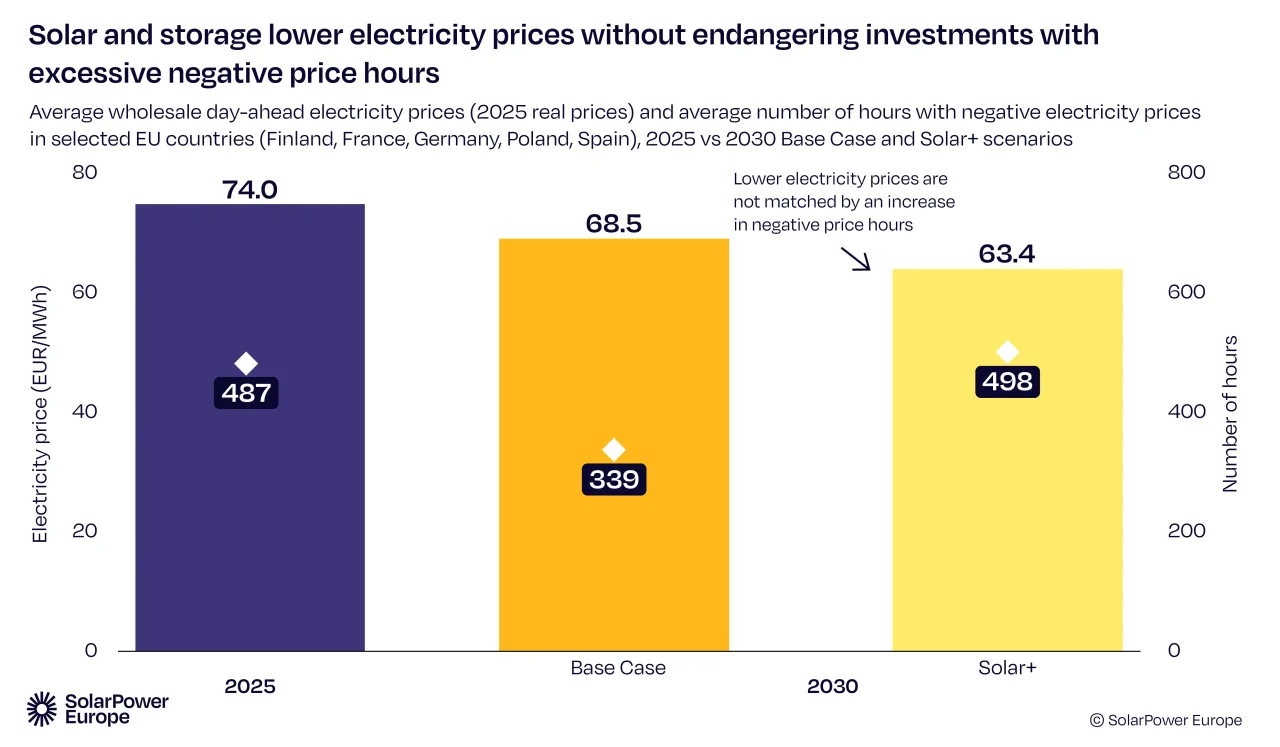
The modelling estimates that the average electricity price would fall to €63.4/MWh by the end of the decade, supported in part by the additional flexibility provided by batteries.
Solar+ could stabilise prices while protecting investors
According to SolarPower Europe, the report identifies a balance point where consumers benefit from lower electricity prices while renewable energy investments remain economically sustainable.
“In the Solar+ scenario, hours with negative prices remain stable between 2025 and 2030, staying below 500 hours per year, protecting renewable energy investors. At the same time, day-ahead wholesale electricity prices fall by more than 10%, benefiting consumers.”


