

Biogas plants play an increasingly strategic role in the energy transition, converting organic waste into renewable electricity, heat and biomethane. As installations scale up and operate continuously, efficiency and reliability depend on technical factors that are often underestimated, first among them, thermal control and gas conditioning.
Discover how Friulair supports efficient and stable biogas operation

From small agricultural units to industrial energy assets
Over the past decade, the biogas industry has transformed from small agricultural installations into fully industrial energy systems. Today’s operators face strict expectations regarding availability, output stability and lifecycle performance, all while managing tighter margins, regulatory constraints and ambitious sustainability targets.
In this context, biogas production is no longer just about generating renewable energy. It is about generating it continuously, predictably and at competitive cost, across seasons and environmental conditions. Even small inefficiencies, when accumulated over thousands of operating hours, have a measurable impact on plant performance and profitability.
24/7 duty in a variable environment
Biogas plants operate around the clock. Digesters, compressors, CHP engines and upgrading units work continuously, often in outdoor environments exposed to wide temperature swings. At the same time, biogas composition and flow fluctuate due to changes in feedstock, biological activity and ambient conditions.
This combination, continuous duty + high variability, creates significant thermal stress across the process. It requires cooling solutions designed specifically for industrial process applications.
Moisture and temperature fluctuations: the quiet inefficiency
Raw biogas leaves the digester warm and saturated with moisture. As temperature shifts along the route, water condenses in piping and equipment, gradually driving corrosion, especially in H₂S-rich environments, acidic condensate formation, fouling of compressors and filters, thermal stress during compression and upgrading, instability in CHP engines and, ultimately, availability losses downstream. These issues often emerge slowly, becoming visible only when stability and maintenance budgets suffer.
Where thermal control becomes critical
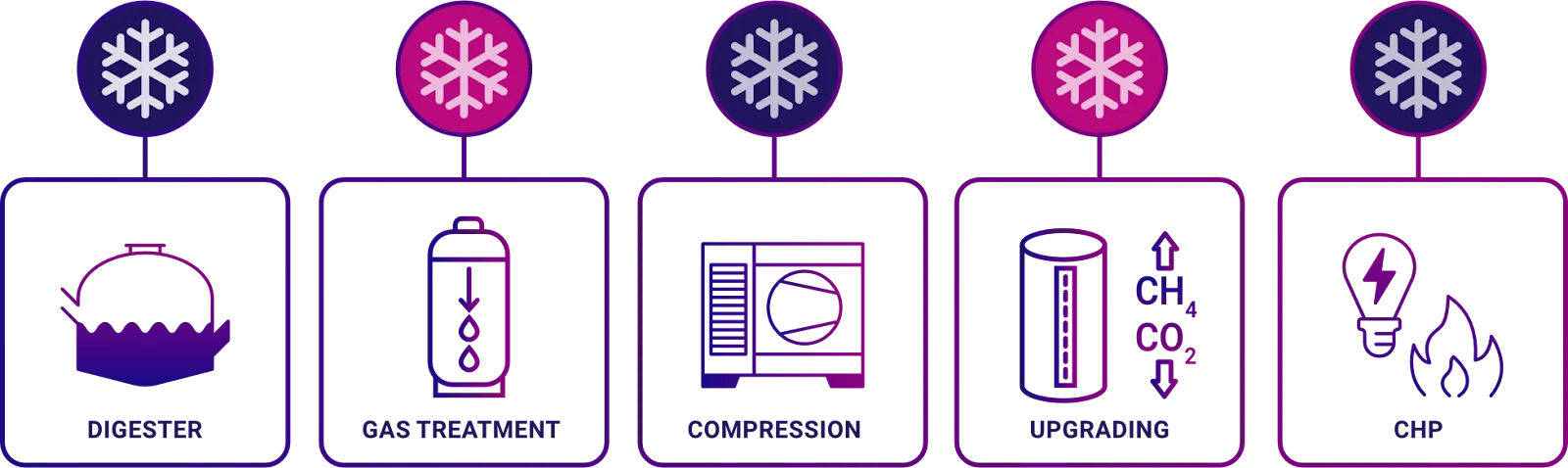
Cooling and temperature stability play a decisive role in several stages of the biogas chain:
- Digester
In anaerobic digestion, stable temperature is essential to maintain microbial activity and gas yield. Even small thermal fluctuations can slow biological reactions, reduce methane production and increase the risk of process imbalance. - Biogas drying and dehumidification
Insufficient cooling prevents proper moisture removal, allowing vapor to travel downstream and condense inside sensitive equipment.
- Compression
Temperature rise is unavoidable. Without controlled cooling, condensate formation increases and thermal stress accelerates wear.
- Upgrading systems
Systems such as membranes, PSA or absorption technologies require stable gas conditions. Moisture and temperature drift compromise separation performance and long-term reliability.
- CHP engines
Variations in gas temperature and residual moisture affect combustion stability, efficiency, and maintenance cycles.
In every case, temperature instability translates directly into operational risk.
The cost of insufficient thermal control
When cooling is considered secondary, plants face higher maintenance efforts, faster corrosion and fouling, more unpredictable production, lower availability in CHP or upgrading and avoidable OPEX increases. These penalties are not inherent to biogas technology; they arise when thermal control is not designed as a process factor.
Cooling as a process factor, not a utility
Industrial process cooling differs from HVAC by design: it is built for 24/7 duty, tight temperature control under changing loads, outdoor-ready construction, and integration with plant logic and monitoring. This approach stabilizes conditions, reduces deviations and supports predictable year-round performance.
What dedicated industrial cooling looks like
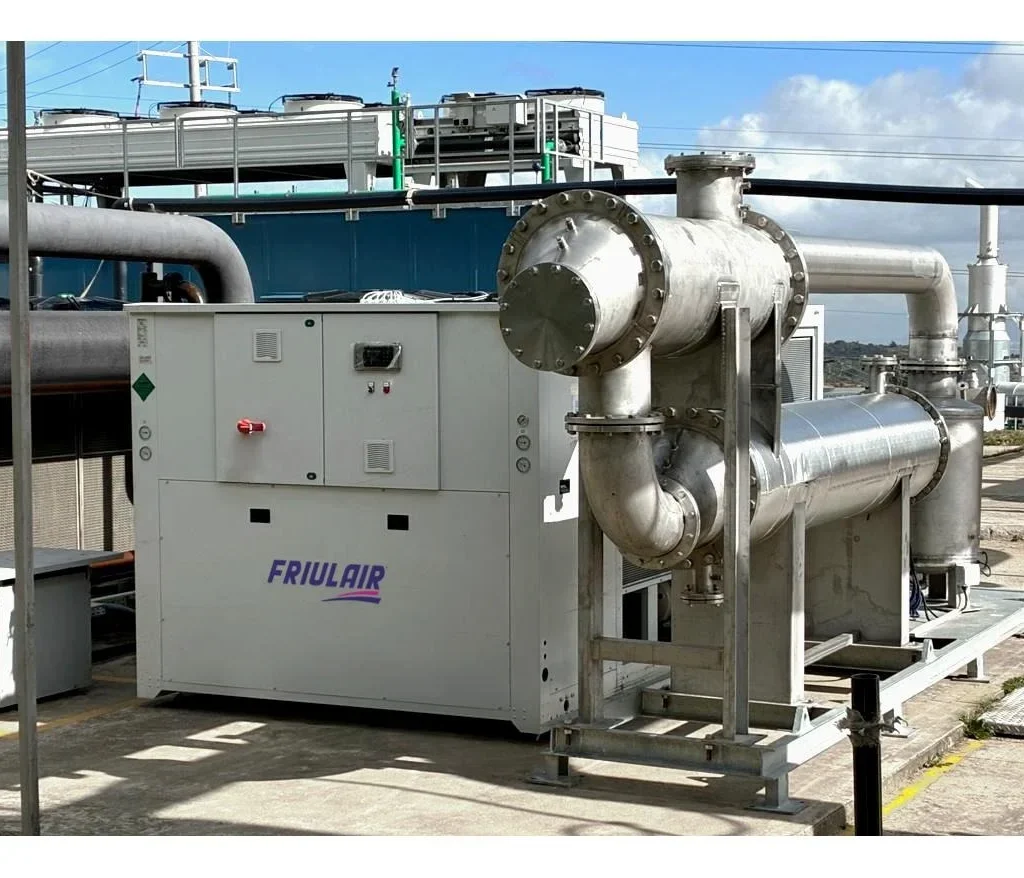
A typical setup combines a process chiller that delivers stable chilled-liquid supply, controlled cooling stages for predictable moisture removal, air-cooled dry coolers (CDC) to handle heat rejection efficiently and enable seasonal free-cooling, and integrated control with alarm management to keep operation steady. The objective is simple: thermal stability across seasons, protecting downstream assets and supporting continuous production.
The Friulair Approach: From Stability To Long-Term Reliability
Built on decades of industrial cooling expertise, Friulair designs and delivers process-grade thermal solutions engineered for biogas applications. Our systems prioritize temperature stability, load responsiveness, outdoor performance and long-term reliability, supporting continuous and predictable plant operation across all seasons.
Friulair helps operators achieve stable operation, reduced operational risk and long-term plant reliability.Below, each benefit is supported by the technical capabilities that enable it and by the technologies available in our biogas-dedicated portfolio.
A – Stable Operation Under Variable Loads
Biogas plants live with changing loads: gas flow, feedstock and seasons shift constantly. Friulair keeps downstream processes within narrow temperature tolerances and reacts fast to these changes, so operation remains steady even in outdoor industrial environments and across wide ambient swings. The result is a predictable process that continues to deliver when conditions move around it.
How Friulair delivers it:
- Process chillers engineered for 24/7 industrial duty, available from 2 kW to 600 kW to match both auxiliary skids and plant‑level loops.
- Electronic Expansion Valve (EEV) technology for stable evaporating conditions and precise modulation.
- Advanced control logic ensuring chilled liquid stability within ±0.1–1.0°C depending on configuration (VBE, VBM).
- Outdoor-ready construction with low‑ambient kits down to –20°C and IP54 electrical protection for reliability in exposed environments.
- High seasonal efficiency, including SEPR HT 5.7 / 6.2 on Infinity Cool models, supporting predictable performance and lower auxiliary consumption.
B – Reduced Operational Risk Across The Line
When gas temperature is stabilized and moisture is removed where intended, thermal stress drops along compression, CHP and upgrading. Deviations driven by temperature are reduced, alarms become rarer and the process behaves more predictably, even during production spikes or summer heat.
How Friulair delivers it:
- Cooling stages designed to support the stabilization of gas temperature and ensure controlled condensate management.
- Heat‑rejection capacity designed to remain reliable even during high ambient temperatures and load peaks (CDC ambient limits –10°C to +45°C).
- Air‑cooled dry coolers (CDC) offering ~300–1200 kW of heat rejection and enabling free‑cooling when ambient conditions allow.
- Outdoor-ready builds featuring EC fans, corrosion‑resistant coil treatments and IP54-rated enclosures for harsh industrial sites.
C – Long-Term Reliability And Lower Lifecycle Costs
Thermal stability translates into higher availability of compressors, CHP engines and upgrading units. Maintenance becomes more predictable and better optimized, and energy use falls when free-cooling cuts compressor run hours during colder months.
How Friulair delivers it:
- Industrial-grade components designed for continuous year‑round operation.
- Dry coolers enabling free‑cooling, reducing compressor run hours during colder months and improving energy efficiency.
- Connectivity and monitoring, including Modbus RTU/TCP, BACnet/IP, MQTT or SNMP on applicable ranges, supporting predictive maintenance.
- Outdoor-ready accessories, low-ambient kits, anticorrosion treatments, IP54 protections, ensuring durability and operational continuity over time.

Conclusion: thermal control as a strategic lever
As biogas plants evolve into fully industrial energy systems, thermal control becomes a strategic driver of performance, not an auxiliary function. Proper cooling supports uptime, safeguards critical equipment, and ensures consistent, profitable operation throughout the plant lifecycle.
Learn how Friulair supports efficient and reliable biogas production.


