


Could future buildings be made entirely of transparent wood, including windows and glazing? The idea is less far-fetched than it may sound. Over the past decade, this engineered biomaterial has emerged as a promising alternative to conventional glass, combining optical performance with thermal insulation and structural benefits.
The evolution of transparent wood as an engineered biomaterial
Transparent wood is natural wood that has been chemically treated to increase its optical transmittance, giving it new versatility. The first version was developed in 2016 at Sweden’s KTH Royal Institute of Technology. Since then, the material has been the subject of continuous research, gaining additional functionalities, including the ability to absorb and release heat.
Recent advances now come from South Korea, where researchers have used this biocomposite to develop an innovative passive smart window. This type of window can regulate the passage of visible light depending on temperature, without additional energy costs.
Passive smart windows using thermochromic transparent wood
A team from Kongju National University and Hanbat National University developed thermochromic transparent wood using liquid crystals for the first time.
To understand the innovation, it is necessary to consider the limitations of existing smart materials.
Limits and advantages of PDLC liquid crystals
Polymer dispersed liquid crystals, known as PDLC, are smart materials capable of switching from opaque to transparent states depending on temperature, thereby regulating light and heat transmission.
However, many PDLC materials are unable to effectively block and modulate ultraviolet radiation. One solution involves integrating composite thin films as filters, but these additions are often fragile and costly.
Technical properties and insulation of transparent balsa wood
The South Korean researchers addressed this issue by developing a new type of transparent wood. They chemically treated balsa, basswood and pine to remove lignin, responsible for the natural dark colour, and bleach the material. The resulting porous structure was then filled with a mixture of thermochromic liquid crystals and optical adhesives.
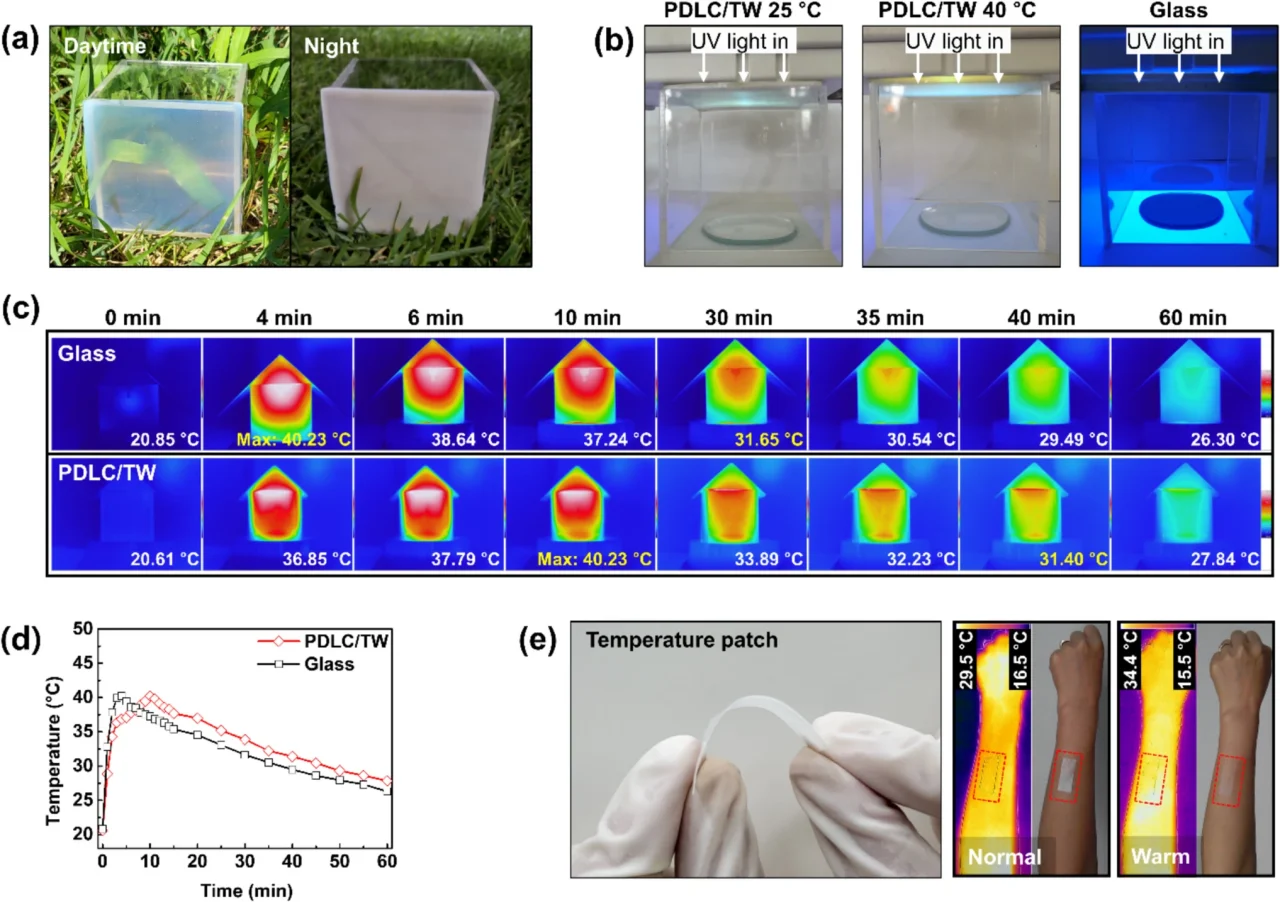
The best performance was achieved with balsa wood. The material demonstrated progressive light transmittance in response to temperature, shifting from opacity, with 28% transmittance at room temperature, to transparency, with 78% transmittance at 40 °C, measured at 550 nm. This confirms fully energy-autonomous light regulation.
In addition, the material blocks almost 100% of UV radiation and has a thermal conductivity of 0.197 W/m/K, making it nearly five times more insulating than conventional glass.
Future applications: green building and wearable devices
“Our innovation is a direct and environmentally friendly substitute for glass, ensuring privacy at night and natural lighting during the day, while reducing HVAC energy costs,” said Professor Jin Kim, who led the research team. “It is ideal for smart greenhouses, as it prevents crop damage by automatically regulating sunlight and maintaining stable indoor temperatures.”
He added that the technology also shows potential for smart wearable devices used in health monitoring. It could function as a flexible patch that becomes transparent when body temperature exceeds 38 °C, providing an immediate visual health alert without batteries or electronic components.
The study, titled Polymer dispersed liquid crystals-impregnated switchable thermochromic transparent woods with excellent ultraviolet blocking performance for smart windows, was published in Advanced Composites and Hybrid Materials (2025), DOI: 10.1007/s42114-025-01481-0.


